
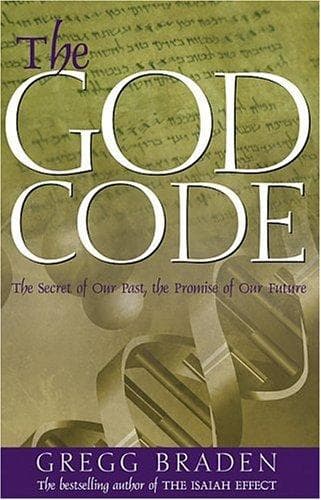
The God Code
رمز الله
Le Code de Dieu
Editorial summary
Gregg Braden's The God Code presents an unconventional argument for divine design through linguistic analysis of human DNA. The work contends that the Hebrew name of God appears encoded within the chemical structure of deoxyribonucleic acid, suggesting an intentional signature left by a creator. Braden draws upon the ancient Jewish practice of gematria, which assigns numerical values to Hebrew letters, to translate the chemical bases of DNA (adenine, thymine, guanine, and cytosine) into corresponding Hebrew characters. Through this methodology, he claims to discover that human genetic code contains the phrase "God eternal within the body" when properly decoded.
The book situates itself within the intelligent design discourse while departing significantly from traditional creationist arguments. Rather than challenging evolutionary theory directly or focusing on biological complexity, Braden proposes that evidence for divine creation exists at the molecular level through meaningful linguistic patterns. His approach combines elements of Jewish mysticism, particularly Kabbalistic interpretation methods, with contemporary genetic science to construct a novel theological argument. The work explicitly challenges materialist explanations of life's origins, though it avoids engagement with mainstream scientific critiques of intelligent design.
Braden's methodology involves correlating the atomic mass of hydrogen, nitrogen, oxygen, and carbon (the primary elements in DNA bases) with Hebrew letters through their numerical equivalents. This process, he argues, reveals intentional communication from a divine source embedded within human biology. The book extends this analysis to suggest that understanding this "code" could transform human consciousness and behavior, bridging scientific and spiritual worldviews.
The work's significance lies less in its scientific rigor, which has been widely criticized by geneticists and linguists, than in its representation of popular attempts to reconcile religious belief with scientific discovery. Braden's synthesis appeals to audiences seeking validation of spiritual beliefs through scientific language and concepts. His argument exemplifies a broader cultural movement that seeks to locate empirical evidence for theological claims within the natural world, particularly through reinterpretation of scientific data. While the book fails to engage seriously with peer-reviewed genetic research or established principles of molecular biology, it demonstrates how intelligent design arguments continue to evolve beyond traditional creationist frameworks, incorporating diverse religious traditions and pseudoscientific methodologies to maintain relevance in contemporary spiritual discourse.
Argument formulations engaged
Related works
Braden, Gregg (2004). The God Code. Hay House.
@book{the-god-code-2004,
  author    = {Braden, Gregg},
  title     = {The God Code},
  year      = {2004},
  publisher = {Hay House},
  url       = {https://god-database.com/en/works/the-god-code-2004}
}