
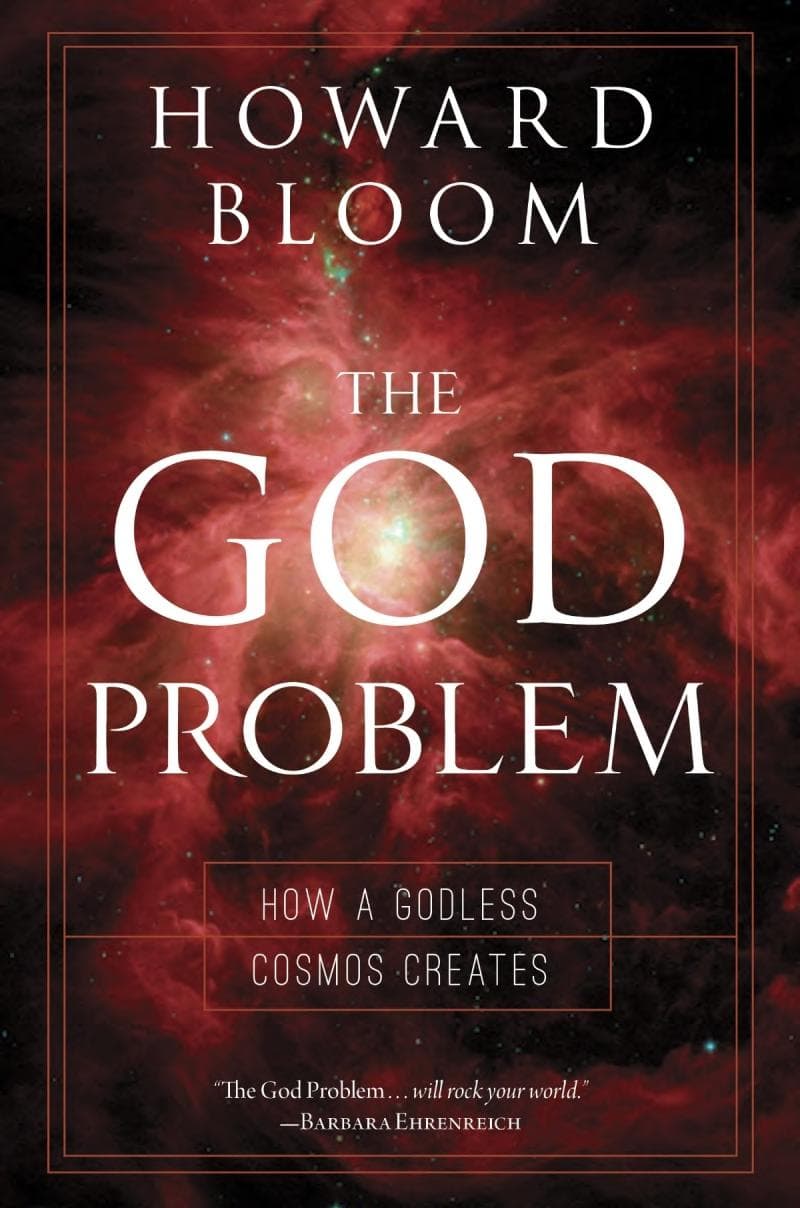
Le problème de Dieu
إشكالية الله
A godless cosmos is itself creative and self-organizing, rendering any appeal to a divine creator explanatorily superfluous.
Editorial summary
Howard Bloom's The God Problem presents an ambitious naturalistic account of cosmic creativity that seeks to explain the universe's apparent design and complexity without recourse to divine agency. The work engages directly with fundamental questions traditionally answered by theistic cosmological and design arguments, offering instead what Bloom terms "the secular genesis story" - an explanation of how the universe generates novelty, order, and apparent purpose through purely natural mechanisms.
Bloom's methodology combines philosophy of science with wide-ranging synthesis across multiple disciplines, from cosmology and quantum mechanics to information theory and complexity science. He frames his investigation around what he calls "the problem of the big bang tautology" - the puzzle of how a universe beginning with minimal ingredients produces extraordinary complexity and apparent design. Rather than invoking a divine designer or prime mover, Bloom argues that five simple rules - what he terms "cosmic creativity tools" - suffice to generate all observed phenomena: simple rules generate complex patterns, repetition creates variation, competition produces cooperation, outsiders spark innovation, and persistence brings transformation.
The work systematically challenges theistic interpretations of cosmic fine-tuning and biological complexity. Against design arguments, Bloom demonstrates how iteration of simple algorithms can produce structures of arbitrary complexity without conscious planning. He particularly emphasizes the role of what he calls "opposites joined at the hip" - dialectical processes where apparent contradictions generate creative tension and novel emergence. This framework allows him to address traditional cosmological puzzles about the origin of order, the arrow of time, and the emergence of consciousness without invoking transcendent causation.
Bloom's contribution to the God debate lies in his attempt to provide a comprehensive alternative to theistic explanations of cosmic creativity. By grounding his account in contemporary science while maintaining philosophical ambition, he offers naturalists a narrative framework for understanding purposiveness in nature without purpose, design without a designer. The work represents a significant entry in the tradition of scientific materialism, extending the explanatory reach of naturalistic philosophy into domains traditionally reserved for theological speculation. His emphasis on creativity and emergence as fundamental cosmic principles provides a distinctive voice in contemporary atheistic philosophy, one that celebrates rather than diminishes the universe's capacity for generating meaning and beauty through purely natural processes.
Structured analysis
Argument formulations engaged
Related works
Bloom, Howard (2012). The God Problem. Prometheus Books.
@book{the-god-problem-how-a-godless-cosmos-cre,
  author    = {Bloom, Howard},
  title     = {The God Problem},
  year      = {2012},
  publisher = {Prometheus Books},
  url       = {https://god-database.com/en/works/the-god-problem-how-a-godless-cosmos-creates}
}