
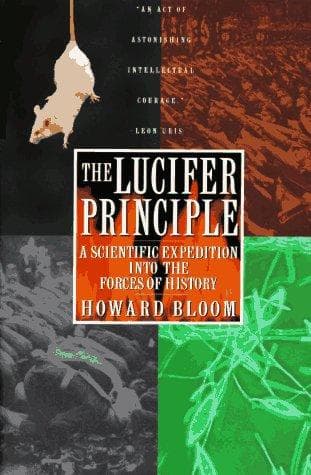
The Lucifer Principle
مبدأ لوسيفر
Le Principe Lucifer
Editorial summary
This provocative work of social theory examines human evil and violence through the lens of evolutionary biology and group selection. Bloom argues that brutality, hierarchy, and intergroup competition represent not aberrations but fundamental organizing principles of human societies, challenging conventional religious and secular moral frameworks. The text's relevance to theological discourse lies in its naturalistic explanation of phenomena traditionally attributed to divine or demonic influence.
The author develops his argument through five core concepts he terms "the Lucifer Principle." These include the superorganism (societies functioning as collective entities), ideas as replicators, the neural net (distributed social intelligence), the pecking order (inevitable hierarchies), and intergroup tournament (perpetual competition between societies). Drawing extensively from ethology, evolutionary psychology, and historical analysis, Bloom contends that what religions conceptualize as evil emerges from the same evolutionary forces that produced human cooperation and culture.
The work directly challenges theodicy and traditional religious explanations of suffering. Where theological systems posit supernatural causes for human cruelty or frame it as deviation from divine intent, Bloom locates violence within nature's fundamental algorithms. His analysis suggests that the behaviors religions condemn as sinful serve adaptive functions that enabled human survival and expansion. This naturalistic framework implicitly undermines arguments for benevolent design or divine providence.
Bloom's methodology combines popular science writing with historical narrative, citing examples from bacterial colonies to modern nation-states. While not explicitly atheistic in tone, the work's implications clearly favor materialist over spiritual explanations for human behavior. The text engages indirectly with religious thought by offering evolutionary alternatives to concepts like original sin, divine punishment, and redemptive suffering.
The book's significance for God-related discourse stems from its comprehensive attempt to explain religiously-charged phenomena through purely naturalistic mechanisms. By presenting cruelty and competition as inevitable products of evolution rather than moral failings or cosmic battles between good and evil, Bloom's analysis poses fundamental challenges to theistic worldviews that ground ethics in divine command or design. His framework suggests that traditional religious responses to evil may misdiagnose both its sources and solutions.
Critics from religious perspectives might argue that Bloom's biological determinism cannot account for human experiences of transcendence, moral intuition, or genuine altruism that exceeds evolutionary advantage. Nevertheless, the work remains influential in debates about whether naturalistic explanations can fully account for phenomena traditionally requiring religious interpretation.
Argument formulations engaged
Related works
Bloom, Howard (1995). The Lucifer Principle.
@book{the-lucifer-principle-1995,
  author    = {Bloom, Howard},
  title     = {The Lucifer Principle},
  year      = {1995},
  url       = {https://god-database.com/en/works/the-lucifer-principle-1995}
}