
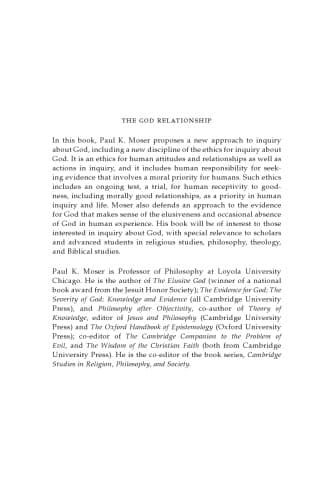
The God Relationship: The Ethics for Inquiry about the Divine
علاقة الله: أخلاقيات البحث عن الإلهي
La Relation à Dieu : L'Éthique de l'Enquête sur le Divin
Editorial summary
This monograph presents Paul K. Moser's distinctive approach to religious epistemology through what he terms "the God relationship." Moser argues that the central question is not whether God exists in some abstract philosophical sense, but whether a morally perfect God seeks transformative relationships with humans. This relational framework fundamentally reshapes how one should approach inquiry about the divine.
Moser contends that traditional natural theology and philosophical arguments for God's existence miss the point by treating God as a theoretical object rather than a personal agent. He develops a "kardiatheology" - a theology of the heart - that emphasizes moral and spiritual transformation over intellectual assent. According to Moser, if a perfectly loving God exists, such a being would not merely provide evidence for detached philosophical analysis but would instead offer evidence aimed at drawing people into morally transformative relationships.
The work critiques both evidentialist approaches that demand publicly observable proofs and fideist positions that abandon rational inquiry altogether. Moser argues these approaches fail because they neglect the ethical dimensions of divine hiddenness. A morally perfect God might remain hidden from those who seek merely speculative knowledge while revealing himself to those willing to undergo moral transformation. This explains why equally intelligent and sincere inquirers reach different conclusions about God's existence.
Central to Moser's argument is the concept of "volitional theism" - the view that experiencing God's reality requires not just intellectual openness but volitional cooperation with divine purposes. He examines how pride, self-sufficiency, and moral resistance can block awareness of divine evidence. The appropriate ethical stance for inquiry about God involves humility, moral seriousness, and willingness to be transformed.
Moser engages extensively with both classical and contemporary philosophy of religion, particularly responding to evidential arguments from divine hiddenness advanced by philosophers like J.L. Schellenberg. He maintains that divine hiddenness serves redemptive purposes by protecting human freedom and filtering out those who seek God for wrong reasons.
The monograph's significance lies in its reframing of religious epistemology around relational and ethical categories rather than purely epistemic ones. Moser challenges the assumption that inquiry about God should follow the same methods as inquiry about impersonal objects, arguing instead that the nature of the divine requires a fundamentally different approach centered on moral transformation and personal relationship.
Argument formulations engaged
Moser, Paul K. (2017). The God Relationship: The Ethics for Inquiry about the Divine. Cambridge University Press.
@book{the-god-relationship-the-ethics-for-inqu,
  author    = {Moser, Paul K.},
  title     = {The God Relationship: The Ethics for Inquiry about the Divine},
  year      = {2017},
  publisher = {Cambridge University Press},
  url       = {https://god-database.com/en/works/the-god-relationship-the-ethics-for-inquiry-about-the-divine-2017}
}