
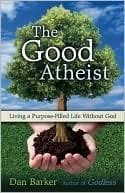
The Good Atheist
الملحد الصالح
Le Bon Athée
Atheists can live fully ethical, meaningful, and compassionate lives without belief in God, demonstrating that morality is grounded in human reason and empathy rather than divine command.
Editorial summary
Dan Barker's "The Good Atheist" presents a distinctive contribution to contemporary atheist literature through its integration of personal narrative with ethical argumentation. The work challenges the widespread assumption that moral living requires religious belief, advancing instead a naturalistic framework for human flourishing grounded in reason, empathy, and secular values.
The monograph employs an autobiographical methodology that distinguishes it from more abstract philosophical treatises on atheism. Barker, a former evangelical preacher turned prominent atheist activist, structures his argument through lived experience, documenting his transition from faith to naturalism while demonstrating how ethical commitment not only survives but strengthens in the absence of theistic belief. This approach serves a dual purpose: it provides empirical evidence against claims that atheism leads to moral nihilism, and it offers a practical roadmap for those navigating similar transitions.
Central to Barker's argument is his engagement with scientific naturalism as a sufficient foundation for ethics. He contends that moral values emerge naturally from human evolution, social cooperation, and rational reflection rather than divine command. The work systematically addresses common theistic objections, particularly the claim that objective morality requires a transcendent source. Barker argues that morality is indeed objective in the sense that it corresponds to real human needs and consequences, but that this objectivity derives from natural facts about sentient beings rather than supernatural decree.
The text situates itself within the broader New Atheist movement while offering a more constructive approach than some contemporaries. Where works by Dawkins or Hitchens often emphasize critique of religion, Barker focuses on building positive alternatives. He develops practical frameworks for secular meaning-making, community building, and ethical decision-making that directly address the existential concerns often cited by religious apologists.
The work's significance lies in its bridging function between philosophical atheism and lived secular ethics. By grounding abstract arguments in personal testimony and practical guidance, Barker provides resources for what he terms "life after faith." His emphasis on the "good" in "good atheist" reframes secular worldviews not as mere negations of theism but as affirmative positions capable of supporting rich moral lives. This positive vision, combined with Barker's insider knowledge of evangelical culture, makes the work particularly effective in engaging religious readers who associate atheism with moral vacancy.
Structured analysis
Argument formulations engaged
Related works
Barker, Dan The Good Atheist. Ulysses Press.
@book{the-good-atheist,
  author    = {Barker, Dan},
  title     = {The Good Atheist},
  year      = {n.d.},
  publisher = {Ulysses Press},
  url       = {https://god-database.com/en/works/the-good-atheist}
}