
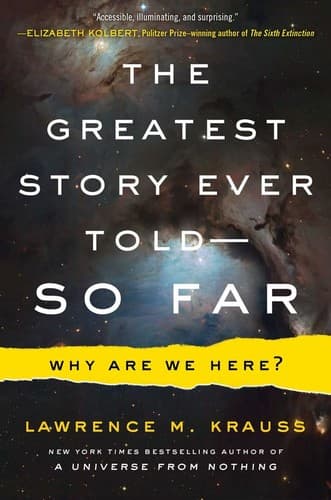
The Greatest Story Ever Told—So Far: Why Are We Here?
أعظم قصة رويت حتى الآن: لماذا نحن هنا؟
La plus grande histoire jamais racontée—jusqu'à présent : Pourquoi sommes-nous ici ?
Editorial summary
Lawrence Krauss's "The Greatest Story Ever Told—So Far" presents a physicist's account of humanity's progressive understanding of the universe, arguing that science provides more compelling answers to existential questions than religious narratives. The work represents a significant contribution to contemporary naturalistic atheism, positioning scientific discovery as both intellectually superior to and emotionally more satisfying than theological explanations.
Krauss structures his argument as a historical narrative, tracing the development of physics from Newton through quantum mechanics to the discovery of the Higgs boson. This methodological approach serves a dual purpose: it demonstrates the cumulative power of scientific inquiry while simultaneously undermining religious claims to eternal truth. By showing how each scientific revolution overturned previous certainties, Krauss implicitly challenges the static nature of theological dogma.
The work engages directly with the question "Why are we here?" traditionally considered theology's domain. Krauss contends that modern physics offers genuine answers through its explanation of how the universe arose from quantum fluctuations and how complexity emerged from simple laws. He argues that the universe requires no external purpose or designer, presenting instead a cosmos that is "more remarkable than any creation myth." This positions him against both traditional theism and contemporary intelligent design arguments.
Krauss's approach reflects the "New Atheist" tradition, sharing with Richard Dawkins and Sam Harris an evangelical fervor for scientific materialism. However, his contribution is distinguished by its emphasis on physics rather than biology or neuroscience. He particularly targets what he sees as the "god of the gaps" fallacy, arguing that science has progressively eliminated spaces where divine action might hide.
The work's significance lies in its attempt to appropriate the emotional and existential territory traditionally claimed by religion. Krauss argues that scientific understanding provides not merely cold facts but genuine wonder, meaning, and even comfort. He presents the scientific story as literally "the greatest story ever told," directly challenging religious narratives' claims to ultimate significance.
Critics might argue that Krauss conflates methodological with metaphysical naturalism, moving too quickly from science's success in explaining physical phenomena to conclusions about ultimate reality. Nevertheless, his work represents a sophisticated example of how contemporary physicists engage theological questions, demonstrating that the science-religion dialogue increasingly occurs on science's terms rather than theology's.
Argument formulations engaged
Related works
Krauss, Lawrence (2017). The Greatest Story Ever Told—So Far: Why Are We Here?. Atria Books.
@book{the-greatest-story-ever-told-so-far-why-,
  author    = {Krauss, Lawrence},
  title     = {The Greatest Story Ever Told—So Far: Why Are We Here?},
  year      = {2017},
  publisher = {Atria Books},
  url       = {https://god-database.com/en/works/the-greatest-story-ever-told-so-far-why-are-we-here-2017}
}