
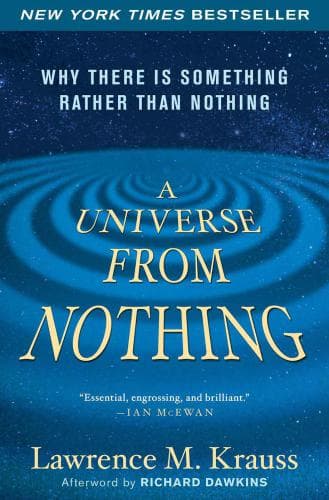
A Universe from Nothing: Why There Is Something Rather than Nothing
كون من العدم: لماذا يوجد شيء بدلاً من لا شيء
Un univers à partir de rien : pourquoi il y a quelque chose plutôt que rien
Editorial summary
Lawrence Krauss's A Universe from Nothing addresses one of the most enduring questions in philosophy and theology: why does anything exist at all? Krauss, a theoretical physicist, argues that modern physics, particularly quantum mechanics and cosmology, provides a naturalistic answer to this question without recourse to supernatural explanation. The work represents a direct challenge to theistic arguments that invoke God as the necessary explanation for existence itself.
Krauss builds his case through a systematic examination of contemporary physics, focusing on quantum field theory and the discovery that empty space is not truly empty but seething with quantum fluctuations. He argues that the universe could have spontaneously arisen from quantum fluctuations in a primordial vacuum state, making the notion of absolute nothingness physically meaningless. The book traces developments from Einstein's general relativity through inflationary cosmology to demonstrate how a universe with net zero energy could emerge from quantum processes without violating conservation laws.
The work explicitly positions itself against theological and philosophical arguments for God's existence, particularly the cosmological argument that everything requires a cause. Krauss contends that physics has redefined what "nothing" means, moving beyond philosophical abstractions to empirically grounded concepts. He argues that the question "why is there something rather than nothing?" may be as meaningless as asking "what is north of the North Pole?" given our current understanding of spacetime and quantum mechanics.
Methodologically, Krauss employs accessible exposition of complex physics while maintaining polemical engagement with religious perspectives. He draws on experimental evidence from particle physics, observational cosmology, and quantum mechanics to construct his naturalistic account. The book includes a controversial afterword by Richard Dawkins that amplifies its anti-theological stance.
The work has sparked significant debate about the relationship between physics and metaphysics. Critics argue that Krauss conflates physical and philosophical concepts of nothingness, and that his quantum vacuum still constitutes "something" requiring explanation. Philosophers and theologians contend that he misunderstands the traditional question about contingent existence. Despite these controversies, the book remains influential in popular science discourse about ultimate origins, crystallizing a physicist's perspective on questions traditionally reserved for philosophy and theology. Its significance lies in articulating how modern physics might address existential questions without invoking divine action.
Argument formulations engaged
Related works
Krauss, Lawrence (2012). A Universe from Nothing: Why There Is Something Rather than Nothing.
@book{a-universe-from-nothing-why-there-is-som,
  author    = {Krauss, Lawrence},
  title     = {A Universe from Nothing: Why There Is Something Rather than Nothing},
  year      = {2012},
  url       = {https://god-database.com/en/works/a-universe-from-nothing-why-there-is-something-rather-than-nothing-2012}
}