
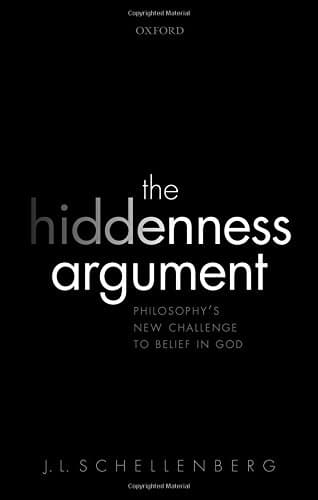
The Hiddenness Argument: Philosophy's New Challenge to Belief in God
حجة الخفاء: التحدي الفلسفي الجديد للإيمان بالله
L'argument de l'occultation : le nouveau défi de la philosophie à la croyance en Dieu
The hiddenness argument constitutes a powerful philosophical challenge to theistic belief, contending that a perfectly loving God would ensure the conditions for conscious relationship with all capable persons, and the evident non-belief of many sincere seekers therefore counts decisively against the existence of such a God.
Editorial summary
Schellenberg's monograph presents the divine hiddenness argument as a formidable new challenge to theistic belief, developing what he considers a more precise and potentially more powerful objection than traditional formulations of the problem of evil. The work systematically argues that the existence of nonresistant nonbelief constitutes decisive evidence against the existence of a perfectly loving God, employing the rigorous conceptual analysis characteristic of contemporary analytic philosophy.
The argument's core innovation lies in its focus on divine love rather than divine power or knowledge. Schellenberg contends that a perfectly loving God would ensure that all persons capable of relationship with the divine would possess at least the belief that God exists, since belief constitutes a necessary condition for such relationship. The existence of nonresistant nonbelievers—those who lack belief in God through no fault of their own—therefore contradicts the existence of such a deity. This approach circumvents many traditional theodicies that address suffering by shifting attention to the cognitive dimension of divine-human relations.
Methodologically, Schellenberg constructs his case through careful conceptual analysis of perfect love, drawing on both philosophical reflection and empirical observations about human relationships. He distinguishes his argument from both evidentialist challenges that focus on the absence of sufficient evidence for God and existentialist concerns about divine silence. The work engages extensively with potential theistic responses, including appeals to human freedom, the value of divine hiddenness, and the possibility of implicit relationship with God.
The monograph's significance extends beyond its immediate challenge to theism. It has generated substantial philosophical literature and forced sophisticated reformulations of both natural theology and philosophical theology. Schellenberg's argument has prompted theistic philosophers to develop more nuanced accounts of divine love, human freedom, and the conditions for divine-human relationship. Within secular-naturalist philosophy, the work exemplifies how traditional philosophical methods can generate novel arguments in philosophy of religion.
The hiddenness argument represents a paradigm shift in philosophical challenges to theism, moving from questions about God's relationship to evil and suffering to questions about God's availability for relationship itself. This reframing has opened new avenues for both critique and defense of theistic belief, establishing divine hiddenness as a central topic in contemporary philosophy of religion alongside the traditional problem of evil.
Argument formulations engaged
Related works
Schellenberg, J. L. The Hiddenness Argument: Philosophy's New Challenge to Belief in God. Oxford University Press.
@book{the-hiddenness-argument-philosophys-new-,
  author    = {Schellenberg, J. L.},
  title     = {The Hiddenness Argument: Philosophy's New Challenge to Belief in God},
  year      = {n.d.},
  publisher = {Oxford University Press},
  url       = {https://god-database.com/en/works/the-hiddenness-argument-philosophys-new-challenge-to-belief-in-god}
}