
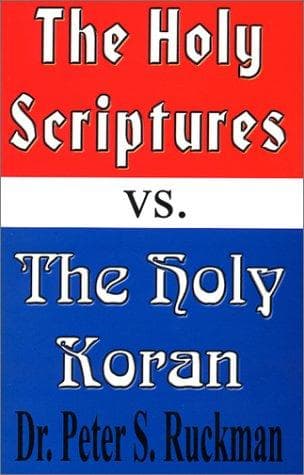
The Holy Scriptures vs. The Holy Koran
الكتاب المقدس في مواجهة القرآن الكريم
Les Saintes Écritures contre le Saint Coran
The Christian Holy Scriptures are presented as superior to the Qur'an in terms of divine authority, prophetic integrity, and textual reliability, with the Qur'an portrayed as a deficient or false alternative revelation.
Editorial summary
This polemical monograph presents a systematic comparative analysis of the Bible and the Quran, arguing for the superiority of Christian scripture through textual criticism and prophetic validation. Ruckman employs a fundamentalist hermeneutic to demonstrate what he considers the divine authenticity of the Bible while challenging the Quran's claims to revelation. The work represents a particular strand of Christian apologetics that seeks to establish the unique truth of Christianity through direct textual confrontation with Islam's sacred text.
The author's methodology centers on parallel textual analysis, examining passages from both scriptures concerning prophecy, historical claims, and theological doctrines. Ruckman particularly emphasizes fulfilled biblical prophecies as evidence of divine inspiration, contrasting these with what he argues are failed or absent predictive elements in the Quran. His approach includes detailed word studies, manuscript comparisons, and historical cross-referencing, though filtered through a distinctly fundamentalist interpretive lens that assumes biblical inerrancy as its starting point.
The work engages directly with Islamic apologetics and Western scholars who advocate for religious pluralism or comparative validity of religious texts. Ruckman challenges both Muslim claims about biblical corruption and academic approaches that treat all scriptures as culturally equivalent human productions. His arguments target specific Islamic doctrines about Jesus, biblical prophets, and salvation, using textual analysis to argue these represent departures from earlier biblical revelation rather than progressive divine disclosure.
Within the broader God debate, this monograph contributes to discussions about religious epistemology and the criteria for evaluating competing revelation claims. While the confrontational tone and predetermined conclusions limit its appeal in interfaith dialogue, the work articulates a particular Christian position on how textual analysis can serve as evidence for divine authorship. The detailed engagement with prophetic texts offers specific test cases for evaluating religious truth claims, even if the methodology remains circular for those not sharing the author's presuppositions.
The significance of Ruckman's work lies less in advancing new arguments than in crystallizing a fundamentalist Christian approach to comparative scripture study. It demonstrates how textual analysis can be deployed in service of exclusivist religious claims, providing insight into how certain Christian communities understand the relationship between their scriptures and competing religious texts in the contemporary pluralistic context.
Structured analysis
Structure of the work
Argument formulations engaged
Ruckman, Peter S. (2001). The Holy Scriptures vs. The Holy Koran.
@book{the-holy-scriptures-vs-the-holy-koran,
  author    = {Ruckman, Peter S.},
  title     = {The Holy Scriptures vs. The Holy Koran},
  year      = {2001},
  url       = {https://god-database.com/en/works/the-holy-scriptures-vs-the-holy-koran}
}