
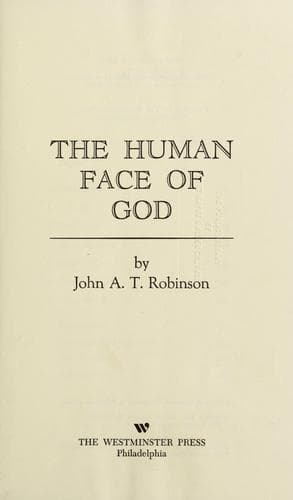
The Human Face of God
الوجه الإنساني لله
Le Visage humain de Dieu
Editorial summary
This work represents Robinson's mature theological reflection on christology, developing themes from his controversial "Honest to God" (1963) while engaging more substantively with biblical scholarship and systematic theology. Robinson argues for a thoroughly humanistic christology that nevertheless affirms Jesus's unique relationship with God, positioning himself against both traditional orthodoxy and reductionist liberalism.
The central thesis challenges the classical two-natures doctrine by proposing that Jesus's divinity consists precisely in his complete humanity. Robinson contends that Jesus represents not God becoming man, but man becoming fully what God intends humanity to be. This formulation attempts to preserve the significance of the incarnation while avoiding what Robinson sees as the philosophical incoherence of traditional formulations. He argues that the patristic categories of substance and nature obscure rather than illuminate the New Testament witness.
Robinson's method combines historical-critical biblical scholarship with existentialist philosophical insights. He examines the development of christological titles in the New Testament, arguing that these emerged from the early church's experience of Jesus rather than from metaphysical speculation. The work engages extensively with contemporary New Testament scholars, particularly those associated with the "new quest" for the historical Jesus, while maintaining dialogue with systematic theologians like Pannenberg and Moltmann.
The philosophical framework draws heavily on process thought and personalist philosophy. Robinson argues that personhood, not substance, provides the proper category for understanding the God-human relationship. He suggests that Jesus's consciousness of God represents the paradigm of human openness to divine presence, making him uniquely "the human face of God" without requiring ontological categories foreign to biblical thought.
This contribution significantly influenced subsequent discussions about the relationship between historical Jesus research and dogmatic christology. Robinson's proposal that high christology can emerge from "below" rather than being imposed from "above" anticipated later developments in liberation and contextual theologies. His rejection of supernatural categories while maintaining religious significance for Jesus positions him as a key figure in liberal Protestant attempts to reformulate traditional doctrine for modern consciousness.
The work's lasting importance lies in its ambitious attempt to bridge the gap between critical scholarship and confessional theology, offering a christology that claims fidelity to both historical investigation and religious experience. While critics from orthodox positions found his proposals inadequate to Christian tradition, and secular scholars questioned his retention of uniqueness claims, Robinson's formulation remains influential in progressive theological circles seeking to articulate faith in contemporary categories.
Argument formulations engaged
Robinson, John A. T. (1973). The Human Face of God.
@book{the-human-face-of-god-1973,
  author    = {Robinson, John A. T.},
  title     = {The Human Face of God},
  year      = {1973},
  url       = {https://god-database.com/en/works/the-human-face-of-god-1973}
}