
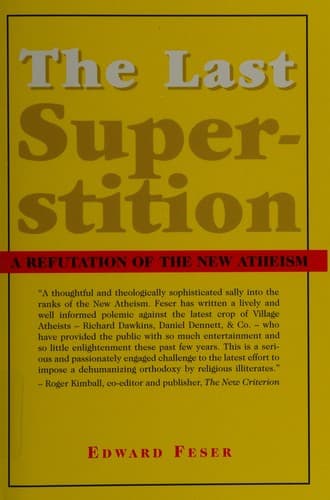
The Last Superstition
الخرافة الأخيرة
La Dernière Superstition
Modern atheism rests on a catastrophic philosophical mistake — the abandonment of Aristotelian-Thomistic metaphysics — and once that classical framework is restored, the existence of God and the bankruptcy of materialism become rationally inescapable.
Editorial summary
Edward Feser's The Last Superstition presents a vigorous philosophical defense of classical theism through a revival of Aristotelian-Thomistic metaphysics. The work positions itself as a direct counteroffensive against the "New Atheist" movement, particularly targeting Richard Dawkins, Christopher Hitchens, Daniel Dennett, and Sam Harris. Feser argues that contemporary atheism rests on what he identifies as the titular "last superstition" - the mechanistic worldview inherited from early modern philosophy's rejection of Aristotelian teleology.
The monograph develops its case through systematic engagement with classical arguments for God's existence, reconceptualized within an Aristotelian metaphysical framework. Feser contends that the cosmological argument, when properly understood through notions of act and potency, demonstrates the necessity of a purely actual being. His treatment of the design argument eschews modern probability-based formulations in favor of teleological considerations rooted in the intrinsic finality of natural substances. The moral argument receives similar treatment, with Feser grounding objective morality in natural law theory rather than divine command.
Methodologically, Feser employs analytical philosophical techniques while drawing extensively from medieval scholasticism, particularly Thomas Aquinas. He argues that the perceived failures of theistic arguments stem not from inherent weaknesses but from their reformulation within post-Cartesian metaphysical assumptions. By returning to pre-modern philosophical categories, Feser maintains that these arguments regain their demonstrative force. The work systematically critiques naturalist alternatives, arguing that materialism cannot adequately account for consciousness, intentionality, or moral obligation.
The text's significance lies in its comprehensive challenge to the philosophical assumptions underlying contemporary atheism. Feser contends that New Atheist critiques typically address caricatures of classical theism, failing to engage with the sophisticated metaphysical framework within which traditional arguments operate. His cumulative case synthesizes multiple argument families into a unified defense of theism, suggesting that properly understood Aristotelian-Thomistic philosophy provides resources for answering contemporary objections to religious belief. The work represents a notable attempt within Christian analytic philosophy to rehabilitate pre-modern metaphysics as intellectually viable in contemporary debate, offering a substantive alternative to both mechanistic naturalism and modern theistic personalism.
Argument formulations engaged
Related works
Feser, Edward (2012). The Last Superstition. Johns Hopkins University Press.
@book{the-last-superstition,
  author    = {Feser, Edward},
  title     = {The Last Superstition},
  year      = {2012},
  publisher = {Johns Hopkins University Press},
  url       = {https://god-database.com/en/works/the-last-superstition}
}