
Editorial summary
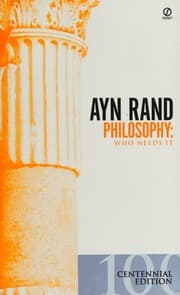
This essay collection represents Ayn Rand's final major work, articulating her Objectivist philosophy through addresses originally delivered between 1962 and 1981. The volume demonstrates Rand's conviction that philosophy constitutes an inescapable human necessity, arguing that the choice lies not between having a philosophy or not, but between holding conscious, rational principles versus unconscious, contradictory ones. Throughout these essays, Rand develops her atheistic worldview while mounting sustained critiques against what she perceives as the mysticism inherent in both traditional religion and modern philosophical movements.
Rand's approach to the God question emerges through her broader epistemological framework, which privileges reason as humanity's sole means of knowledge acquisition. The collection systematically rejects any form of faith-based belief, positioning religious conviction as fundamentally opposed to rational thought. Her essay "Faith and Force: The Destroyers of the Modern World" exemplifies this stance, arguing that mysticism—whether religious or secular—inevitably leads to authoritarian political systems. Rand contends that belief in God represents an abdication of rational judgment, substituting external authority for independent thought.
The work engages critically with both medieval theology and contemporary religious philosophy, though Rand reserves particular criticism for modern attempts to reconcile faith with reason. She argues that Aquinas's synthesis of Aristotelian philosophy with Christian theology initiated a philosophical decline that culminated in Kant's critical philosophy, which she views as providing secular mysticism with intellectual respectability. This historical narrative positions atheism not merely as absence of belief but as a positive commitment to rational, this-worldly values.
Methodologically, Rand employs polemical argumentation rather than systematic philosophical analysis, addressing general audiences while maintaining philosophical rigor. Her rhetorical strategy involves demonstrating the practical consequences of philosophical ideas, particularly how religious metaphysics translates into ethics and politics. The collection's significance for the God debate lies in its articulation of a comprehensive atheistic philosophy that extends beyond mere disbelief to propose an alternative value system based entirely on reason and individual rights. Rand's influence on libertarian thought and the modern atheist movement makes this work particularly relevant for understanding 20th-century secular philosophy's relationship to religious questions, even as her categorical dismissal of faith limits engagement with sophisticated theological arguments.
Argument formulations engaged
Related works
Rand, Ayn (1982). Philosophy: Who Needs It.
@book{philosophy-who-needs-it-1982,
  author    = {Rand, Ayn},
  title     = {Philosophy: Who Needs It},
  year      = {1982},
  url       = {https://god-database.com/en/works/philosophy-who-needs-it-1982}
}