
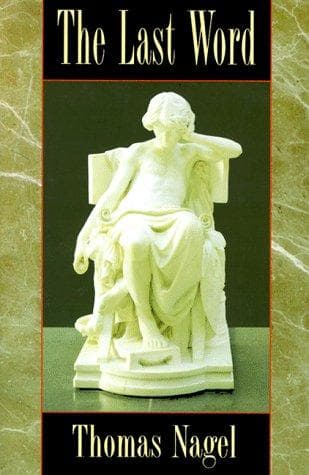
The Last Word
الكلمة الأخيرة
Le Dernier Mot
Editorial summary
This work examines the foundations of rational thought and their implications for philosophical inquiry, including questions about religious belief and objective truth. Nagel argues that reason possesses an irreducible authority that cannot be explained away through naturalistic, historicist, or relativistic accounts. He contends that any attempt to debunk reason as merely contingent, evolved, or culturally constructed must itself rely on rational argumentation, thereby affirming reason's inescapable normative force.
The monograph develops this thesis through critical engagement with various forms of skepticism about reason. Nagel addresses evolutionary explanations that treat logical and mathematical intuitions as mere survival mechanisms, arguing that such accounts cannot explain why these intuitions should be trusted to reveal genuine truths about reality. He similarly critiques historicist and sociological attempts to relativize reason to particular cultural contexts, demonstrating how these positions undermine themselves by claiming universal validity for their own relativistic insights.
Central to Nagel's argument is the notion that certain fundamental logical principles and forms of thought cannot be coherently doubted because any attempt at doubt must presuppose their validity. This applies not only to formal logic but extends to substantive reasoning about ethics, science, and metaphysics. While not primarily focused on theistic questions, the work has significant implications for debates about God's existence. Nagel's defense of reason's objectivity challenges both naturalistic atheism that reduces rationality to evolutionary byproducts and fideistic approaches that divorce faith from rational justification.
The philosopher's method combines careful conceptual analysis with sustained critique of contemporary philosophical positions, particularly those emerging from post-modern and naturalistic traditions. His approach recalls the rationalist tradition while engaging seriously with its modern critics. By defending reason's autonomy and authority, Nagel preserves space for meaningful philosophical discourse about ultimate questions, including religious ones, against reductive materialisms and radical skepticisms.
The work's significance for the God debate lies in its robust defense of objective rational standards that make substantive metaphysical arguments possible. Without accepting reason's fundamental authority, neither theistic arguments nor atheistic critiques can claim genuine philosophical validity. Nagel thus provides essential groundwork for any serious engagement with questions about divine existence, showing why such debates cannot be dismissed as merely subjective preferences or evolutionary illusions but must be evaluated through rigorous rational inquiry.
Argument formulations engaged
Related works
Nagel, Thomas (1997). The Last Word. Oxford University Press.
@book{the-last-word-1997,
  author    = {Nagel, Thomas},
  title     = {The Last Word},
  year      = {1997},
  publisher = {Oxford University Press},
  url       = {https://god-database.com/en/works/the-last-word-1997}
}