
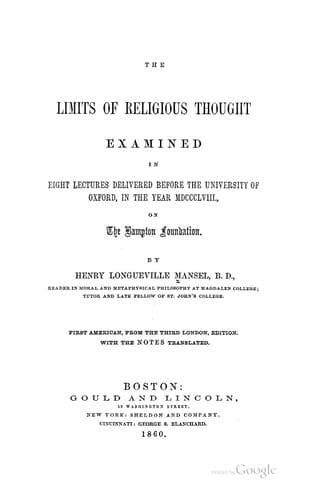
The Limits of Religious Thought
حدود الفكر الديني
Les Limites de la pensée religieuse
Editorial summary
This monograph represents a significant intervention in Victorian debates about religious epistemology and the knowability of God. Mansel develops a sophisticated argument about the inherent limitations of human cognition when applied to divine matters, positioning himself within the Kantian tradition while engaging contemporary theological controversies.
The work's central thesis holds that human reason faces insurmountable constraints when attempting to comprehend the infinite and absolute nature of God. Mansel argues that the human mind, being finite and conditioned by temporal and spatial categories, cannot genuinely grasp divine attributes such as omnipotence, omniscience, or infinity. These concepts, when subjected to rigorous philosophical analysis, generate contradictions and antinomies that reveal the inadequacy of rational theology.
Mansel directs his critique particularly against rationalist theologians and German idealists who claim to demonstrate God's existence and nature through pure reason. He challenges both the ontological argument and attempts to deduce divine attributes from first principles, arguing that such enterprises inevitably anthropomorphize God by projecting human categories onto the divine. His analysis extends to religious philosophers who attempt to reconcile divine foreknowledge with human freedom, or divine goodness with the existence of evil, suggesting these problems arise from illegitimately applying finite concepts to infinite realities.
The philosophical method employed draws heavily on Kantian critical philosophy, particularly the distinction between phenomena and noumena. Mansel adapts Kant's epistemological framework to theological questions, arguing that just as human knowledge cannot penetrate to things-in-themselves, so religious thought cannot comprehend God's essential nature. This approach places him in dialogue with both British empiricists and continental idealists, offering a middle path between skepticism and dogmatism.
The work's significance lies in its influence on subsequent debates about religious language and theological method. By arguing for the limits of religious thought while maintaining the validity of religious faith, Mansel provides intellectual grounds for a form of Christian belief that acknowledges mystery and revelation rather than claiming rational demonstration. His position anticipates later developments in negative theology and fideism, while his rigorous philosophical analysis establishes parameters for what theological discourse can legitimately claim. The monograph thus serves as a crucial text for understanding how nineteenth-century thinkers negotiated between Enlightenment rationalism and traditional religious commitment.
Argument formulations engaged
Mansel, Henry Longueville (1858). The Limits of Religious Thought. Cambridge University Press.
@book{the-limits-of-religious-thought-1858,
  author    = {Mansel, Henry Longueville},
  title     = {The Limits of Religious Thought},
  year      = {1858},
  publisher = {Cambridge University Press},
  url       = {https://god-database.com/en/works/the-limits-of-religious-thought-1858}
}