
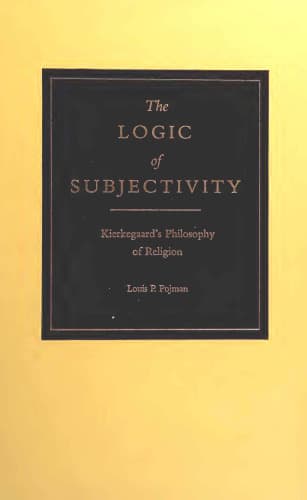
The Logic of Subjectivity: Kierkegaard's Philosophy of Religion
منطق الذاتية: فلسفة كيركجارد الدينية
La Logique de la Subjectivité : La Philosophie de la Religion de Kierkegaard
Editorial summary
This monograph provides a systematic examination of Kierkegaard's philosophy of religion, focusing on the Danish thinker's understanding of faith as essentially subjective and paradoxical. Pojman reconstructs Kierkegaard's critique of Hegelian rationalism and its attempt to subsume religion within a comprehensive philosophical system. The work demonstrates how Kierkegaard develops an alternative conception of religious truth that privileges passionate inwardness over objective demonstration.
The analysis centers on Kierkegaard's distinction between objective and subjective approaches to religious questions. Where objective inquiry seeks demonstrable proofs and universal truths about God's existence, subjective appropriation concerns the individual's passionate relationship to religious claims. Pojman explicates how this framework challenges both natural theology's rational proofs and historical criticism's evidential approach to Christianity. The work shows Kierkegaard arguing that the objective path necessarily fails because it misconceives the nature of religious truth, which requires personal commitment rather than detached analysis.
Pojman carefully traces the development of Kierkegaard's position through his pseudonymous works, particularly Concluding Unscientific Postscript and Fear and Trembling. The exposition reveals how Kierkegaard's concept of truth as subjectivity does not reduce to mere relativism but rather identifies a distinct epistemic category for religious belief. The work examines the notorious claim that faith requires a leap beyond reason, showing how Kierkegaard grounds this in the absolute paradox of the incarnation, which allegedly transcends human understanding.
The monograph situates Kierkegaard's project within 19th-century debates between rationalist philosophy and Christian orthodoxy. Pojman demonstrates how Kierkegaard's position offers a third way that neither capitulates to Enlightenment demands for rational justification nor retreats into fideistic anti-intellectualism. The analysis addresses key interpretive controversies, including whether Kierkegaard's emphasis on subjective truth undermines any claim to religious knowledge and how his account relates to contemporary epistemological discussions.
This work contributes significantly to understanding a major challenge to rational theology and religious epistemology. By clarifying Kierkegaard's logic of subjectivity, Pojman illuminates an influential position that continues to shape debates about the relationship between faith and reason, the nature of religious truth, and the limits of philosophical analysis in addressing questions about God.
Argument formulations engaged
Pojman, Louis P. (1984). The Logic of Subjectivity: Kierkegaard's Philosophy of Religion. University of Alabama Press.
@book{the-logic-of-subjectivity-kierkegaards-p,
  author    = {Pojman, Louis P.},
  title     = {The Logic of Subjectivity: Kierkegaard's Philosophy of Religion},
  year      = {1984},
  publisher = {University of Alabama Press},
  url       = {https://god-database.com/en/works/the-logic-of-subjectivity-kierkegaards-philosophy-of-religion-1984}
}