
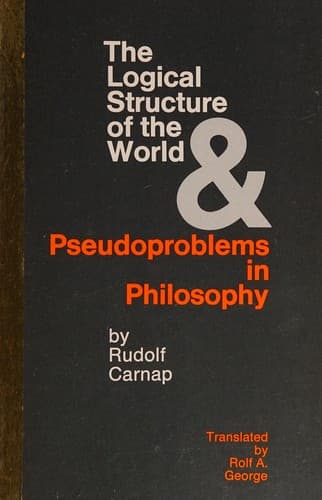
The Logical Structure of the World
البنية المنطقية للعالم
La Structure logique du Monde
Editorial summary
Rudolf Carnap's "The Logical Structure of the World" represents a foundational text in logical positivism that profoundly shapes how philosophical discourse approaches questions about God and metaphysics. Published in 1928, this monograph develops a comprehensive system of "constitutional theory" that attempts to reconstruct all knowledge from a phenomenalistic base using purely logical relations. While not explicitly focused on theological questions, the work establishes methodological principles that fundamentally challenge traditional approaches to discussing divine existence.
Carnap constructs an elaborate formal system beginning with elementary experiences and ascending through logical construction to physical objects, other minds, and cultural objects. His method employs symbolic logic and set theory to demonstrate how all meaningful concepts can be reduced to or constructed from basic experiential elements. This reductionist program implies that any concept failing such construction lacks cognitive meaning. The work's significance for theological discourse lies precisely in this criterion: concepts of God, as traditionally conceived in theology and metaphysics, cannot be constitutionally derived from the experiential base Carnap identifies.
The monograph emerges from the Vienna Circle's intellectual milieu, where logical analysis was viewed as philosophy's primary tool. Carnap explicitly distinguishes between legitimate scientific knowledge and metaphysical pseudo-statements, arguing that the latter arise from logical confusion rather than genuine cognitive content. His constitutional system provides the technical apparatus for this distinction, demonstrating through formal construction what counts as meaningful discourse.
For debates about God, Carnap's contribution proves double-edged. His system excludes traditional theological claims from the realm of theoretical knowledge, suggesting they lack truth-value altogether. However, he acknowledges that such statements might possess emotional or motivational significance, anticipating his later distinction between cognitive and non-cognitive meaning. The work thus reconfigures rather than resolves the God question, shifting focus from truth to meaningfulness.
The monograph's lasting influence stems from its rigorous demonstration that accepting certain epistemological starting points necessarily constrains what can meaningfully be said about God. While later philosophers challenged Carnap's phenomenalistic base and strict verification criteria, his systematic approach to meaning continues to shape discussions about religious language. The work remains essential for understanding how logical positivism transformed the intellectual landscape within which modern debates about God occur, establishing parameters that subsequent thinkers must either accept or explicitly reject.
Argument formulations engaged
Related works
Carnap, Rudolf (1928). The Logical Structure of the World.
@book{the-logical-structure-of-the-world-1928,
  author    = {Carnap, Rudolf},
  title     = {The Logical Structure of the World},
  year      = {1928},
  url       = {https://god-database.com/en/works/the-logical-structure-of-the-world-1928}
}