
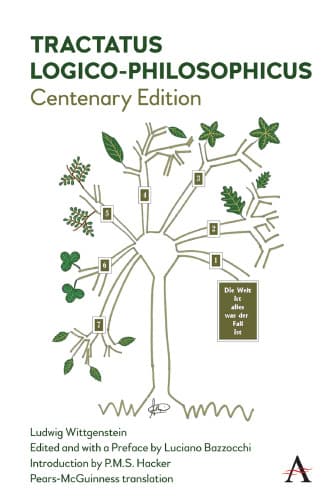
Tractatus Logico-Philosophicus
الرسالة المنطقية الفلسفية
Editorial summary
The Tractatus Logico-Philosophicus represents Wittgenstein's early attempt to delimit the boundaries of meaningful language through rigorous logical analysis, with profound implications for theological discourse. While not explicitly focused on the God debate, the work systematically undermines traditional philosophical theology by establishing strict criteria for what can be meaningfully said.
Wittgenstein develops a picture theory of language wherein propositions function as logical pictures of facts in the world. Only statements that mirror possible states of affairs possess sense; everything else falls outside the realm of meaningful discourse. This austere framework emerges from his engagement with Frege's and Russell's logical atomism, though Wittgenstein radicalizes their project by drawing metaphysical conclusions from logical analysis.
The work's seventh and final proposition, "Whereof one cannot speak, thereof one must be silent," encapsulates its theological implications. Since God transcends the empirical world of facts, theological statements fail to picture any possible state of affairs. Traditional arguments for God's existence, theodicies, and doctrinal claims about divine attributes all violate the limits of meaningful language. Wittgenstein thus dismantles centuries of natural theology not through direct refutation but by revealing its fundamental linguistic confusion.
However, the Tractatus does not embrace simple atheism. Wittgenstein acknowledges the mystical dimension of existence, noting that the world's existence itself remains inexplicable within his framework. Ethics, aesthetics, and religious experience belong to what shows itself but cannot be said. This creates space for religious attitudes while denying theology any cognitive content.
The work's influence on twentieth-century philosophy of religion proves paradoxical. Logical positivists embraced its apparent demolition of metaphysics, developing verification principles that rendered religious language meaningless. Yet Wittgenstein himself later rejected this interpretation, and religious thinkers found in the Tractatus resources for apophatic theology and non-cognitive understandings of faith.
The Tractatus matters for the God debate because it shifts the terrain from arguments about divine existence to questions about religious language itself. By severing the connection between religious discourse and factual claims, it challenges both traditional theism and rationalist atheism. The work suggests that the most profound questions about God, meaning, and value transcend the boundaries of rational discourse, residing instead in the realm of the unsayable that nevertheless makes itself manifest in human experience.
Argument formulations engaged
Related works
Wittgenstein, Ludwig (1921). Tractatus Logico-Philosophicus. Annalen der Naturphilosophie.
@book{tractatus-logico-philosophicus-1921,
  author    = {Wittgenstein, Ludwig},
  title     = {Tractatus Logico-Philosophicus},
  year      = {1921},
  publisher = {Annalen der Naturphilosophie},
  url       = {https://god-database.com/en/works/tractatus-logico-philosophicus-1921}
}