
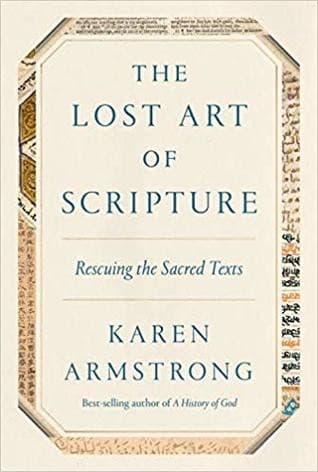
The Lost Art of Scripture: Rescuing the Sacred Texts
الفن المفقود للكتاب المقدس: إنقاذ النصوص المقدسة
L'Art Perdu de l'Écriture : Sauver les Textes Sacrés
Editorial summary
This monograph examines the historical development and interpretive traditions of sacred texts across major world religions, arguing that contemporary fundamentalist readings represent a departure from centuries of more fluid, contextual hermeneutical practices. Armstrong traces how Jewish, Christian, Islamic, Hindu, Buddhist, and Confucian communities historically approached their scriptures through allegorical, mystical, and adaptive methods rather than literal interpretation.
The work contends that pre-modern religious communities understood sacred texts as requiring continual reinterpretation to address changing circumstances. Armstrong demonstrates how rabbinical Judaism developed midrashic techniques to expand biblical meanings, early Christians employed typological readings to reimagine Hebrew scriptures, and Islamic scholars distinguished between outer and inner meanings in the Quran. She argues these interpretive traditions recognized scripture as speaking to multiple levels of understanding simultaneously, requiring readers to move beyond surface meanings.
Central to Armstrong's thesis is the claim that literalist approaches to scripture emerged primarily through modern encounters with scientific rationalism and colonial disruption. She traces how Protestant emphasis on sola scriptura, combined with Enlightenment epistemology, produced new expectations that sacred texts function as historically accurate documents rather than vehicles for spiritual transformation. The work examines how colonialism prompted defensive literalism among Hindu and Buddhist communities, while Islamic fundamentalism arose partly through rejection of traditional exegetical methods.
Armstrong's methodology combines intellectual history with comparative religion, drawing on extensive scholarship in scriptural hermeneutics across traditions. She positions her argument against both religious fundamentalists who claim exclusive access to original meaning and secular critics who dismiss scripture as primitive superstition. The work suggests recovering traditional interpretive flexibility could address contemporary religious conflict and alienation.
The monograph contributes to debates about religious authority and textual interpretation by challenging assumptions about how sacred texts functioned historically. Armstrong implies that modern literalism represents not authentic tradition but innovation, suggesting possibilities for religious communities to reclaim more nuanced hermeneutical approaches. While not directly addressing God's existence, the work engages questions about divine communication and religious epistemology by examining how communities have understood revelation through texts. Her analysis suggests that scripture's significance lies less in propositional content about deity than in its capacity to generate ongoing meaning within lived religious practice.
Argument formulations engaged
Armstrong, Karen (2019). The Lost Art of Scripture: Rescuing the Sacred Texts. Knopf.
@book{the-lost-art-of-scripture-rescuing-the-s,
  author    = {Armstrong, Karen},
  title     = {The Lost Art of Scripture: Rescuing the Sacred Texts},
  year      = {2019},
  publisher = {Knopf},
  url       = {https://god-database.com/en/works/the-lost-art-of-scripture-rescuing-the-sacred-texts-2019}
}