
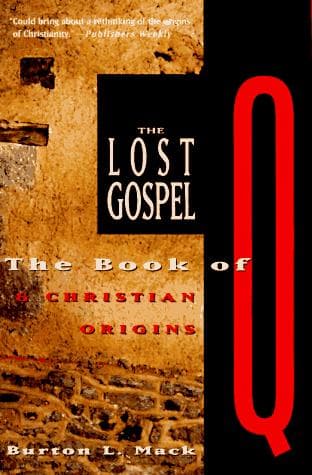
The Lost Gospel
الإنجيل المفقود
L'Évangile perdu
Editorial summary
Burton Mack's "The Lost Gospel" presents a radical reassessment of Christian origins through detailed analysis of the hypothetical Q source, challenging traditional theological narratives about Jesus and early Christianity. Mack argues that the earliest recoverable layer of Christian tradition reveals not a divine savior figure but rather a countercultural sage whose followers formed a social movement without initial messianic or apocalyptic expectations. This reconstruction fundamentally questions the theological foundations upon which Christian claims about God's intervention in history have traditionally rested.
The work employs source-critical methodology to isolate and analyze the Q document, a theoretical collection of Jesus's sayings believed to predate the canonical gospels. Mack stratifies Q into three distinct layers, arguing that the earliest stratum contains wisdom teachings devoid of supernatural elements, while later redactions progressively introduce apocalyptic themes and divine claims. This literary archaeology enables him to trace how a philosophical movement evolved into a religious cult centered on Jesus's divine status. His approach synthesizes insights from form criticism, redaction criticism, and social-historical analysis, positioning early Christianity within the broader context of Hellenistic philosophy and Jewish wisdom traditions.
Mack's reconstruction directly challenges both conservative Christian scholarship that assumes gospel reliability and liberal theological attempts to recover an authentic historical Jesus compatible with traditional faith claims. He argues that the mythologization of Jesus as divine Son of God represents a secondary development driven by social and political pressures rather than historical memory. This thesis undermines appeals to revealed truth or divine self-disclosure through Jesus, suggesting instead that Christianity's god-concept emerged through human cultural processes of myth-making and social formation.
The implications extend beyond historical Jesus research to fundamental questions about religious epistemology and the nature of divine revelation. If Mack's analysis holds, then Christianity's central theological claims rest not on historical events of divine-human encounter but on sociological dynamics of community formation and identity construction. His work thus contributes to naturalistic explanations of religious phenomena, treating god-concepts as human constructs rather than responses to transcendent reality. While not explicitly arguing against theism, Mack's historical reconstruction removes key evidentiary supports for specifically Christian theological claims, effectively advancing a secular understanding of religious origins that treats divine categories as interpretive overlays rather than historical realities.
Argument formulations engaged
Related works
Mack, Burton (1993). The Lost Gospel. Harpercollins.
@book{the-lost-gospel-1993,
  author    = {Mack, Burton},
  title     = {The Lost Gospel},
  year      = {1993},
  publisher = {Harpercollins},
  url       = {https://god-database.com/en/works/the-lost-gospel-1993}
}