
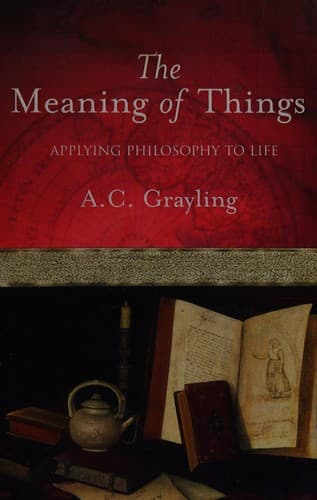
The Meaning of Things
معنى الأشياء
Le Sens des choses
A secular humanist collection of short philosophical essays arguing that ethics, meaning, and the good life can be fully grounded in reason and human experience without recourse to religion or theistic belief.
Editorial summary
This collection of philosophical essays examines fundamental aspects of human experience through a secular humanist lens, offering naturalistic accounts of meaning, morality, and value while systematically critiquing religious approaches to these questions. Grayling develops his arguments across meditations on topics including love, death, happiness, suffering, and ethical living, consistently demonstrating how these dimensions of experience can be understood and navigated without recourse to supernatural explanations or divine authority.
The work engages primarily with moral arguments for theism by presenting a comprehensive alternative framework for ethics grounded in reason, empathy, and human flourishing. Grayling contends that morality emerges from our nature as social beings capable of reflection, rather than requiring divine command or cosmic purpose. He argues that secular ethics proves more robust than religious morality precisely because it responds to actual human needs and circumstances rather than appealing to transcendent authority. This approach directly challenges divine command theory and religious claims to moral superiority.
Methodologically, Grayling employs accessible philosophical exposition that draws on literature, history, and personal reflection while maintaining analytical rigor. His essay format allows him to approach the God question obliquely through examining how religious and secular worldviews differently interpret core human experiences. This strategy enables him to build a cumulative case against theistic frameworks by showing their explanatory inadequacy across multiple domains of life.
The text situates itself within the tradition of Enlightenment rationalism and contemporary scientific naturalism, explicitly invoking thinkers like Hume and Russell while engaging with modern cognitive science and evolutionary theory. Grayling positions religious belief as a historically understandable but ultimately outdated response to existential questions that secular philosophy can now address more adequately. He particularly targets the presumption that meaning and morality require religious grounding, arguing this assumption reflects intellectual laziness rather than necessity.
The work's significance lies in its comprehensive articulation of positive secular humanism that moves beyond mere critique of religion. By demonstrating how naturalistic philosophy can provide rich accounts of meaning and guidance for living, Grayling challenges the common accusation that atheism leads to nihilism or moral relativism. His essays thus contribute to broader debates about whether human flourishing requires religious belief, offering detailed counterexamples to claims that secular worldviews impoverish human experience or fail to address existential concerns.
Structured analysis
Argument formulations engaged
Related works
Grayling, A. C. The Meaning of Things. Weidenfeld & Nicolson.
@book{the-meaning-of-things,
  author    = {Grayling, A. C.},
  title     = {The Meaning of Things},
  year      = {n.d.},
  publisher = {Weidenfeld & Nicolson},
  url       = {https://god-database.com/en/works/the-meaning-of-things}
}