
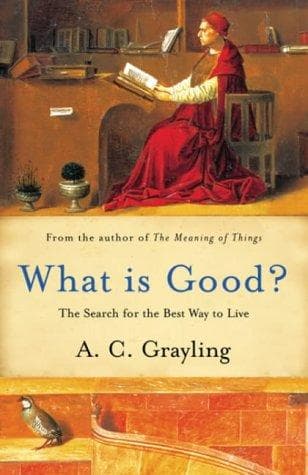
What Is Good? The Search for the Best Way to Live
ما هو الخير؟ البحث عن أفضل طريقة للعيش
Qu'est-ce qui est bien ? La recherche de la meilleure façon de vivre
Editorial summary
A. C. Grayling's "What Is Good?" presents a comprehensive philosophical inquiry into ethics and the foundations of moral life, offering a distinctly secular framework for understanding human flourishing. The work systematically examines how individuals and societies can determine ethical principles without recourse to religious authority or divine command, positioning itself as a humanist alternative to theologically grounded moral systems.
Grayling structures his argument through historical analysis, tracing the development of ethical thought from ancient Greek philosophy through the Enlightenment to contemporary moral theory. He demonstrates how questions about the good life have been addressed through reason, experience, and human reflection rather than revelation. The work engages critically with religious ethical frameworks, arguing that morality neither requires nor benefits from supernatural grounding. Instead, Grayling contends that ethics emerges from human nature, social cooperation, and rational deliberation about consequences and principles.
Central to Grayling's thesis is the claim that secular ethics provides a more robust and defensible foundation for moral life than religious alternatives. He examines various ethical traditions—virtue ethics, deontology, consequentialism—showing how each contributes to understanding moral questions without invoking divine authority. The work particularly emphasizes the Enlightenment tradition, defending reason and empirical observation as sufficient bases for ethical judgment against critics who claim that without God, morality becomes merely subjective or relativistic.
The book explicitly challenges theistic meta-ethics, particularly divine command theory and natural law approaches that ground morality in God's will or creation. Grayling argues these approaches face insurmountable philosophical difficulties, including the Euthyphro dilemma and the problem of conflicting religious moral claims. He advocates instead for a naturalistic understanding of ethics rooted in human psychology, social needs, and rational reflection.
Grayling's contribution to debates about God lies in his systematic demonstration that meaningful, objective ethics can exist independently of religious belief. By providing detailed philosophical arguments and historical evidence for secular morality, he challenges the common assumption that rejection of God entails moral nihilism. The work serves as both a philosophical treatise and a practical guide, showing how individuals can live ethically meaningful lives through reason, compassion, and humanistic values rather than religious faith.
Argument formulations engaged
Related works
Grayling, A. C. (2003). What Is Good? The Search for the Best Way to Live. Weidenfeld & Nicolson.
@book{what-is-good-the-search-for-the-best-way,
  author    = {Grayling, A. C.},
  title     = {What Is Good? The Search for the Best Way to Live},
  year      = {2003},
  publisher = {Weidenfeld & Nicolson},
  url       = {https://god-database.com/en/works/what-is-good-the-search-for-the-best-way-to-live-2003}
}