
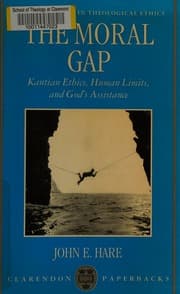
The Moral Gap: Kantian Ethics, Human Limits, and God's Assistance
الفجوة الأخلاقية: أخلاقيات كانط والحدود البشرية ومساعدة الله
L'Écart moral : L'Éthique kantienne, les Limites humaines et l'Assistance de Dieu
Editorial summary
This monograph examines the profound tension between Kant's moral philosophy and human moral capability, arguing that divine assistance provides the necessary resolution to this fundamental ethical problem. Hare identifies what he terms the "moral gap" - the chasm between what Kantian ethics demands of moral agents and what human beings can actually achieve given their natural limitations and propensity toward self-interest.
The work engages critically with Kant's moral philosophy, particularly the categorical imperative and its requirement for pure moral motivation untainted by self-interest. Hare demonstrates that Kant himself recognized this gap between moral obligation and human capacity, though subsequent secular interpretations of Kantian ethics have often minimized or ignored this crucial dimension. The author traces how Kant's own solution involved postulating God's existence as a practical necessity - not as a theoretical proof but as a requirement for the coherence of the moral life.
Hare's analysis proceeds through three main movements. First, he establishes the severity of moral demands within Kantian ethics, showing how the requirement for moral perfection and pure motivation exceeds human psychological and practical capacities. Second, he examines various secular attempts to bridge this gap through moral education, social reform, or revised interpretations of Kant's demands, arguing that each falls short of resolving the fundamental tension. Third, he develops a constructive account of how divine assistance functions to make moral life possible without undermining human moral agency or responsibility.
The monograph makes a significant contribution to both Kantian scholarship and philosophy of religion by demonstrating that theistic commitments are not merely additions to Kant's ethical system but integral to its coherence. Hare challenges prevailing secular readings of Kant that treat his religious postulates as dispensable remnants of his pietistic background. Instead, he shows that the moral gap problem persists in any rigorous deontological ethics and that theological resources provide uniquely adequate solutions.
This work particularly matters for contemporary debates about the relationship between morality and religious belief. Against those who argue for the complete independence of ethics from theology, Hare presents a sophisticated case that certain moral frameworks - particularly those making stringent demands on human agents - require theological supplementation to remain psychologically realistic and philosophically coherent. His argument revives neglected aspects of Kant's thought while addressing perennial questions about human moral capacity and divine grace.
Argument formulations engaged
Related works
Hare, John (1996). The Moral Gap: Kantian Ethics, Human Limits, and God's Assistance. Oxford University Press, USA.
@book{the-moral-gap-kantian-ethics-human-limit,
  author    = {Hare, John},
  title     = {The Moral Gap: Kantian Ethics, Human Limits, and God's Assistance},
  year      = {1996},
  publisher = {Oxford University Press, USA},
  url       = {https://god-database.com/en/works/the-moral-gap-kantian-ethics-human-limits-and-gods-assistance-1996}
}