
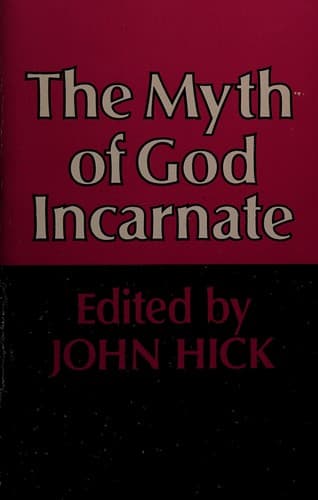
The Myth of God Incarnate
أسطورة الإله المتجسد
Le mythe de Dieu incarné
The classical Christian doctrine of the Incarnation — that Jesus of Nazareth was literally God made flesh — is a mythological or metaphorical expression that cannot be sustained historically or philosophically, and must be reinterpreted in non-literal terms.
Editorial summary
This provocative collection, edited by John Hick, represents a watershed moment in twentieth-century Christian theology, challenging the traditional doctrine of the Incarnation through rigorous historical-critical analysis. The volume brings together seven British theologians who argue that the belief in Jesus Christ as God incarnate should be understood as mythological rather than literal truth. The contributors employ historical-critical methods to examine the development of incarnational doctrine, tracing its evolution from the New Testament through patristic formulations to contemporary belief.
The work's central thesis contends that the doctrine of the Incarnation emerged gradually through a process of theological development rather than originating with Jesus or his immediate followers. Contributors demonstrate how early Christian communities employed available religious and philosophical categories from their Hellenistic environment to express their experience of Jesus, eventually crystallizing into the metaphysical claims of Nicaea and Chalcedon. This historical reconstruction suggests that incarnational language functioned primarily as devotional and liturgical expression rather than ontological description.
Hick and his collaborators engage directly with traditional Christian apologetics, particularly challenging the notion that scripture mandates belief in Christ's divinity. Through careful exegetical work, they argue that New Testament texts traditionally cited as proof of incarnation admit alternative interpretations more consistent with their original contexts. The volume also addresses the religious diversity argument, suggesting that exclusive claims about Christ's divinity create unnecessary barriers to interfaith dialogue and understanding.
The work's methodology reflects the broader influence of historical criticism on modern theology, applying to christology the same analytical tools previously directed at biblical texts. This approach situates religious claims within their historical and cultural matrices, distinguishing between original meaning and subsequent doctrinal development. The contributors argue that recognizing the mythological character of incarnational language need not diminish its religious significance but rather liberates it for contemporary reappropriation.
The volume's impact extends beyond academic theology, challenging ordinary believers to reconsider fundamental assumptions about Christian identity. By proposing that orthodox christology represents one culturally conditioned response to the Christ event rather than divinely revealed truth, the work opens space for alternative theological constructions. This skeptical stance toward traditional formulations sparked intense controversy, generating numerous responses defending classical christology and precipitating ongoing debates about the relationship between historical criticism and theological truth claims.
Structured analysis
Argument formulations engaged
Related works
Hick, John The Myth of God Incarnate. Hymns Ancient & Modern Ltd.
@book{the-myth-of-god-incarnate,
  author    = {Hick, John},
  title     = {The Myth of God Incarnate},
  year      = {n.d.},
  publisher = {Hymns Ancient & Modern Ltd},
  url       = {https://god-database.com/en/works/the-myth-of-god-incarnate}
}