
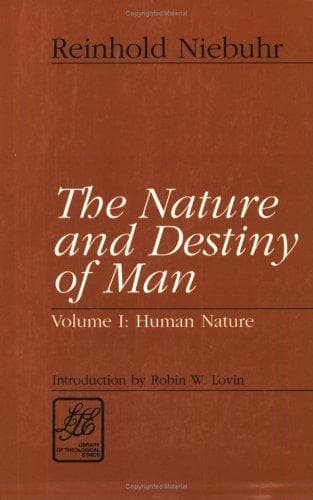
The Nature and Destiny of Man
طبيعة ومصير الإنسان
La Nature et le Destin de l'Homme
Editorial summary
Reinhold Niebuhr's The Nature and Destiny of Man represents one of the twentieth century's most influential theological anthropologies, offering a sophisticated reinterpretation of Christian doctrine that directly engages modern philosophy's challenge to traditional theism. Written against the backdrop of totalitarianism and world war, this two-volume work develops a dialectical understanding of human nature that grounds both religious faith and social ethics in the paradoxical structure of human existence itself.
Niebuhr constructs his argument through a critical dialogue with both classical Christian theology and modern secular thought. He rejects what he sees as the naive optimism of liberal theology and secular progressivism, which minimize human sinfulness and overestimate reason's capacity for self-transcendence. Simultaneously, he critiques orthodox Christianity's tendency toward otherworldly escapism and its failure to address concrete historical existence. His method combines biblical exegesis with phenomenological analysis of human consciousness, drawing particularly on Kierkegaard's understanding of anxiety and freedom.
The work's central thesis concerns the fundamental paradox of human nature: humans are simultaneously finite and free, embedded in nature yet capable of transcending it through self-consciousness. This paradoxical structure generates anxiety, which becomes the precondition for both human creativity and sin. Sin emerges not from finitude itself but from the prideful attempt to deny human limitations or, conversely, from the sensual escape from freedom's responsibilities. Niebuhr argues that only the Christian doctrine of grace adequately addresses this predicament, offering both judgment upon human pretension and the possibility of redemption through divine love.
Against naturalistic reductionism and idealistic abstractions, Niebuhr insists that the God-question cannot be resolved through speculative metaphysics but must be approached through the concrete dynamics of moral and spiritual experience. His analysis of how human self-transcendence points beyond itself to a transcendent ground provides a distinctive argument for theism that avoids both rational proofs and mere fideism. The work's influence extends beyond theology to political theory and social ethics, as Niebuhr demonstrates how properly understanding human nature's religious dimension proves essential for realistic social analysis and moral action. His synthesis of prophetic biblical faith with modern existential insights establishes a form of Christian realism that continues to shape contemporary discussions about religion's role in public life and the relationship between divine transcendence and human responsibility.
Argument formulations engaged
Related works
Niebuhr, Reinhold (1941). The Nature and Destiny of Man. Westminster John Knox Press.
@book{the-nature-and-destiny-of-man-1941,
  author    = {Niebuhr, Reinhold},
  title     = {The Nature and Destiny of Man},
  year      = {1941},
  publisher = {Westminster John Knox Press},
  url       = {https://god-database.com/en/works/the-nature-and-destiny-of-man-1941}
}