
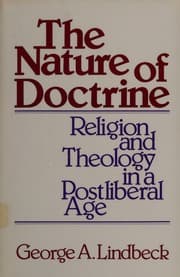
The Nature of Doctrine: Religion and Theology in a Postliberal Age
طبيعة العقيدة: الدين واللاهوت في عصر ما بعد الليبرالية
La Nature de la Doctrine : Religion et Théologie à l'ère postlibérale
Editorial summary
George Lindbeck's The Nature of Doctrine presents a groundbreaking reconceptualization of religious doctrine and theological method that fundamentally challenges how scholars understand religious truth claims, including those about God. Writing in response to both liberal experiential-expressivism and conservative propositionalism, Lindbeck proposes a "cultural-linguistic" approach that treats religions as comprehensive interpretive frameworks analogous to languages or cultures rather than as collections of propositions or expressions of universal religious experience.
The work's central contribution to theological discourse lies in its reframing of how religious communities make claims about divine reality. Rather than viewing doctrines as either objective propositions about God (the cognitivist approach) or symbolic expressions of universal religious experiences (the experiential-expressivist approach), Lindbeck argues that doctrines function as grammatical rules governing religious speech and practice within particular communities. This cultural-linguistic model suggests that statements about God gain their meaning not from correspondence to metaphysical reality or from expressing pre-linguistic experiences, but from their use within the lived practices of religious communities.
Lindbeck develops this approach through careful engagement with philosophy of language, cultural anthropology, and sociology of knowledge, drawing particularly on Wittgenstein's language games and Geertz's thick description. His analysis demonstrates how religious truth operates intratextually—that is, meaning emerges from within the narrative world that scripture creates rather than from external referents. This move allows him to maintain the integrity of religious truth claims while avoiding both fundamentalist literalism and liberal reductionism.
The implications for understanding God-talk prove revolutionary. Lindbeck's framework suggests that theological statements about God function not as metaphysical descriptions but as rules for communal speech and action. This approach preserves the particularity of different religious traditions while enabling genuine interfaith dialogue, since religions can be understood as distinct "languages" with their own internal coherence rather than competing truth claims about the same referent.
The work's influence extends across theological method, philosophy of religion, and religious studies, offering a postliberal alternative that takes seriously both the linguistic turn in philosophy and the cultural embeddedness of religious practice. By reconceiving how religious language operates, Lindbeck provides theologians with tools for articulating faith commitments without either capitulating to secular reason or retreating into fideistic isolation.
Argument formulations engaged
Related works
Lindbeck, George (1984). The Nature of Doctrine: Religion and Theology in a Postliberal Age. Presbyterian Publishing Corporation.
@book{the-nature-of-doctrine-religion-and-theo,
  author    = {Lindbeck, George},
  title     = {The Nature of Doctrine: Religion and Theology in a Postliberal Age},
  year      = {1984},
  publisher = {Presbyterian Publishing Corporation},
  url       = {https://god-database.com/en/works/the-nature-of-doctrine-religion-and-theology-in-a-postliberal-age-1984}
}