
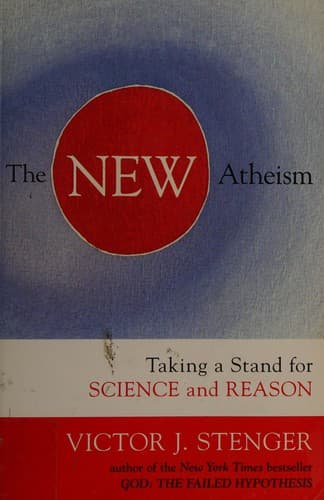
The New Atheism: Taking a Stand for Science and Reason
الإلحاد الجديد: اتخاذ موقف للعلم والعقل
Le Nouvel Athéisme : Prendre Position pour la Science et la Raison
Editorial summary
Victor J. Stenger's The New Atheism: Taking a Stand for Science and Reason presents a systematic defense of the New Atheist movement while advancing his own scientific arguments against theism. Writing as both a physicist and philosopher, Stenger positions himself alongside Richard Dawkins, Sam Harris, Daniel Dennett, and Christopher Hitchens, though he distinguishes his approach through a more rigorous application of physics and cosmology to theological questions.
The work operates on two levels. First, Stenger defends New Atheism against common criticisms that it represents merely another form of fundamentalism or that it inadequately engages sophisticated theology. He argues that the movement's direct, uncompromising stance reflects not dogmatism but intellectual honesty about the incompatibility between scientific naturalism and religious claims. Against theologians who argue that science and religion occupy separate magisteria, Stenger contends that religions make testable empirical claims about reality that fall within science's purview.
Second, and more substantially, Stenger develops his own case against theism grounded in contemporary physics. He argues that the universe exhibits no evidence of design, that natural processes fully account for cosmic and biological complexity, and that the notion of immaterial souls or consciousness contradicts established neuroscience. Drawing on his earlier work, he examines specific theistic arguments—fine-tuning, cosmological, and teleological—demonstrating how each fails when subjected to rigorous scientific analysis. His treatment of quantum mechanics challenges both mystical appropriations and theological interpretations of quantum indeterminacy.
Stenger's distinctive contribution lies in his systematic application of scientific methodology to religious truth claims. Where other New Atheists rely primarily on evolutionary biology or philosophical critique, Stenger marshals evidence from across the physical sciences. He argues that atheism represents not merely the absence of belief but a positive worldview grounded in empirical investigation and rational inquiry.
The monograph matters for several reasons. It provides the most scientifically detailed argument within New Atheist literature, offers a physicist's perspective on design arguments, and articulates a vision of secular ethics based on reason and human welfare. While critics may challenge his dismissal of non-empirical ways of knowing, Stenger's work stands as a forceful statement of scientific naturalism's challenge to theistic belief, demonstrating how contemporary physics renders traditional god-concepts increasingly implausible.
Argument formulations engaged
Related works
Stenger, Victor J. (2009). The New Atheism: Taking a Stand for Science and Reason. Prometheus Books.
@book{the-new-atheism-taking-a-stand-for-scien,
  author    = {Stenger, Victor J.},
  title     = {The New Atheism: Taking a Stand for Science and Reason},
  year      = {2009},
  publisher = {Prometheus Books},
  url       = {https://god-database.com/en/works/the-new-atheism-taking-a-stand-for-science-and-reason-2009}
}