
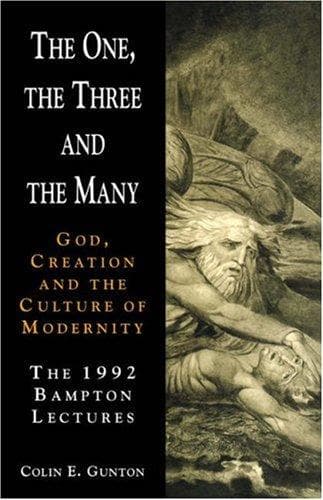
The One, the Three and the Many: God, Creation and the Culture of Modernity
الواحد والثلاثة والمتعدد: الله والخلق وثقافة الحداثة
L'Un, les Trois et le Multiple : Dieu, la Création et la Culture de la Modernité
Editorial summary
Colin Gunton's monograph presents a comprehensive theological diagnosis of modernity's intellectual and cultural crisis, arguing that Western thought's rejection of trinitarian theology has produced profound dislocations in contemporary understanding of both God and creation. The work contends that modernity's problems stem fundamentally from inadequate conceptions of divine transcendence and immanence, which have generated false dichotomies between unity and plurality, universality and particularity, divine action and human freedom.
Gunton traces these difficulties to Augustine's psychological analogies for the Trinity, which he argues privileged unity over plurality and interiority over relationality. This Augustinian legacy, combined with medieval modifications and Enlightenment rejections of trinitarian thought, has produced what Gunton diagnoses as modernity's characteristic pathologies: excessive individualism coupled with totalizing systems, fragmented knowledge alongside reductive universalisms, and oscillations between determinism and arbitrary freedom. The author examines how these patterns manifest across multiple domains, from political theory to aesthetics, demonstrating how deficient theology generates cultural malformation.
The work's constructive proposal centers on recovering a robustly trinitarian understanding of God as constituted by the mutual relations of Father, Son, and Spirit. Drawing particularly on the Cappadocian fathers and recent trinitarian theologians like Barth and Zizioulas, Gunton develops an ontology of personhood and relation that applies analogically to creation. This approach yields a vision where unity and diversity, transcendence and immanence, divine sovereignty and creaturely freedom exist in proper relation rather than opposition. The Trinity provides the conceptual resources for understanding how the one and the many can be reconciled without reduction in either direction.
Gunton's methodology combines historical genealogy with systematic theological construction, engaging critically with major philosophical figures from Plato through Hegel to demonstrate how non-trinitarian or anti-trinitarian frameworks inevitably distort both divine and created reality. The work represents a significant contribution to debates about modernity's origins and failures, offering trinitarian theology not merely as religious doctrine but as essential intellectual framework for addressing contemporary cultural aporias. While some critics question Gunton's reading of Augustine and his assessment of modernity's uniformly negative character, the work's influence on subsequent theological engagement with modern thought remains substantial.
Argument formulations engaged
Gunton, Colin (1993). The One, the Three and the Many: God, Creation and the Culture of Modernity.
@book{the-one-the-three-and-the-many-god-creat,
  author    = {Gunton, Colin},
  title     = {The One, the Three and the Many: God, Creation and the Culture of Modernity},
  year      = {1993},
  url       = {https://god-database.com/en/works/the-one-the-three-and-the-many-god-creation-and-the-culture-of-modernity-1993}
}