
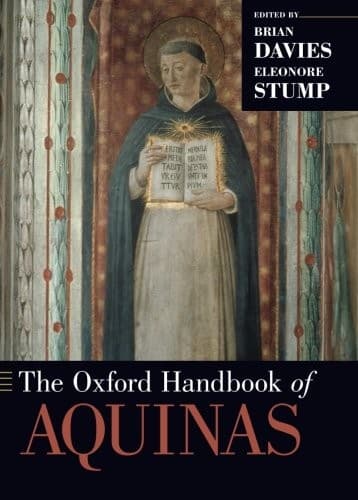
The Oxford Handbook of Aquinas
دليل أكسفورد لتوما الأكويني
Le Manuel Oxford d'Aquin
Editorial summary
This comprehensive handbook presents Aquinas's philosophical and theological system as a sophisticated framework for understanding God's existence and nature. The volume assembles leading scholars to examine how Aquinas develops rational demonstrations for divine existence while maintaining the ultimate incomprehensibility of the divine essence. Contributors explore his synthesis of Aristotelian philosophy with Christian revelation, showing how natural reason and faith complement rather than contradict each other in approaching questions about God.
The handbook illuminates Aquinas's Five Ways as philosophical arguments that proceed from observable features of the world to God as their necessary cause. These demonstrations receive detailed analysis, with authors examining both their historical context and contemporary relevance. The collection addresses standard objections to cosmological and teleological arguments while presenting Aquinas's responses within his broader metaphysical framework. Particular attention goes to his distinction between essence and existence, which grounds his argument that God alone exists necessarily while all creatures exist contingently.
Davies and his contributors examine how Aquinas navigates between kataphatic and apophatic theology, affirming certain divine attributes while emphasizing that God transcends human conceptual categories. The volume explores his doctrine of divine simplicity, showing how God's existence, essence, and attributes are identical rather than distinct. This leads to sophisticated discussions of how religious language functions analogically when applied to God, avoiding both univocity and pure equivocation.
The handbook situates Aquinas within thirteenth-century debates while demonstrating his ongoing relevance to philosophy of religion. Contributors engage contemporary analytic philosophy, showing how Thomistic insights address modern discussions about divine action, providence, and the problem of evil. The volume examines Aquinas's influence on later thinkers while defending his positions against common misinterpretations.
By presenting Aquinas as both historically significant and philosophically vital, this handbook advances understanding of classical theism's intellectual resources. The collection demonstrates how rigorous philosophical analysis can support rather than undermine religious belief, offering a systematic alternative to both fideism and reductive naturalism. Through careful exposition of Aquinas's arguments and concepts, the volume shows why his synthesis remains influential in contemporary debates about God's existence and nature.
Argument formulations engaged
Related works
Davies, Brian (2012). The Oxford Handbook of Aquinas. Oxford University Press.
@book{the-oxford-handbook-of-aquinas-2012,
  author    = {Davies, Brian},
  title     = {The Oxford Handbook of Aquinas},
  year      = {2012},
  publisher = {Oxford University Press},
  url       = {https://god-database.com/en/works/the-oxford-handbook-of-aquinas-2012}
}