
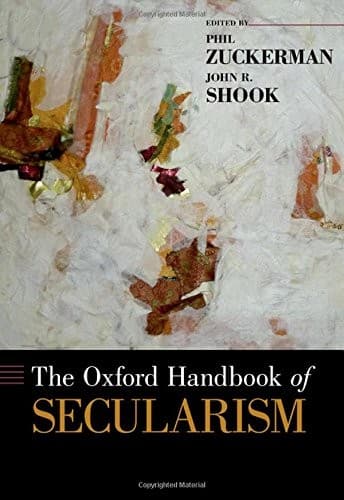
The Oxford Handbook of Secularism
دليل أكسفورد للعلمانية
Manuel d'Oxford de la laïcité
Editorial summary
This comprehensive volume examines secularism as a multifaceted global phenomenon, offering empirical analysis of its manifestations across diverse cultural contexts while challenging assumptions about religious decline and secular advancement. Zuckerman assembles leading scholars to investigate secularism not as a monolithic ideology but as varied processes of differentiation, pluralization, and institutional change that reshape relationships between religious and non-religious spheres.
The handbook's methodological approach privileges sociological and anthropological perspectives, employing comparative analysis to demonstrate how secularization unfolds differently across nations and regions. Contributors examine secularism's political dimensions, from constitutional frameworks separating church and state to grassroots secular movements advocating for non-religious rights. The volume particularly emphasizes empirical data on growing populations identifying as non-religious, atheist, or agnostic, while avoiding simplistic narratives of inevitable religious decline.
Central to the work's argument is the distinction between secularization as social process and secularism as ideological position. Authors explore how modernization produces functional differentiation without necessarily diminishing religious belief or practice. The handbook examines secular worldviews as positive meaning systems rather than mere absences of religion, analyzing how non-religious individuals construct ethics, community, and purpose. Case studies from Scandinavia to East Asia illustrate how cultural contexts shape secular expressions, from state-enforced atheism to organic religious indifference.
The volume engages critically with classical secularization theory, particularly challenging linear models proposed by earlier sociologists. Contributors demonstrate how religious resurgence, fundamentalism, and new spiritualities complicate predictions of steadily advancing secularism. The handbook addresses contemporary debates about secular privilege, religious freedom, and the challenges facing non-believers in predominantly religious societies.
Zuckerman's collection makes significant contributions by treating secularism as a legitimate object of academic study requiring sophisticated theoretical frameworks. The work moves beyond Western-centric perspectives, incorporating postcolonial critiques and examining how secularism intersects with issues of gender, race, and class. By presenting secularism as internally diverse and culturally contingent, the handbook enriches understanding of contemporary religious landscapes while providing resources for analyzing the increasing visibility of non-religious populations globally. This empirically grounded approach offers valuable insights for scholars studying religious change, political theory, and the evolving relationship between belief and unbelief in modern societies.
Argument formulations engaged
Related works
Zuckerman, Phil (2017). The Oxford Handbook of Secularism. Oxford University Press.
@book{the-oxford-handbook-of-secularism-2017,
  author    = {Zuckerman, Phil},
  title     = {The Oxford Handbook of Secularism},
  year      = {2017},
  publisher = {Oxford University Press},
  url       = {https://god-database.com/en/works/the-oxford-handbook-of-secularism-2017}
}