
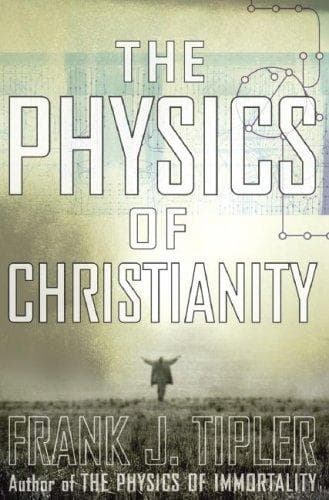
The Physics of Christianity
فيزياء المسيحية
La Physique du christianisme
Editorial summary
Frank J. Tipler's The Physics of Christianity represents one of the most ambitious attempts to reconcile modern physics with Christian theology through rigorous mathematical argumentation. Expanding on his earlier work in The Anthropic Cosmological Principle (1986) and The Physics of Immortality (1994), Tipler argues that fundamental physics not only permits but actually requires the truth of Christianity's central doctrines.
The work employs quantum mechanics, general relativity, and particle physics to demonstrate what Tipler considers the scientific inevitability of Christian claims. He contends that the singularity physics of the Big Bang corresponds to creation ex nihilo, that quantum mechanics explains the virgin birth through spontaneous particle generation, and that the many-worlds interpretation of quantum mechanics provides a mechanism for miracles. Most controversially, Tipler argues that the Shroud of Turin bears evidence of particle physics consistent with dematerialization during resurrection, and that the resurrection itself represents a quantum mechanical phenomenon involving baryon annihilation.
Tipler's methodology rests on what he calls the Omega Point Theory, proposing that the universe must evolve toward a final singularity possessing infinite computational capacity. This endpoint, he argues, constitutes the Christian God, who will resurrect all beings through quantum reconstruction. He maintains that this conclusion follows necessarily from the known laws of physics, particularly the unitarity principle in quantum mechanics which requires information conservation.
The work positions itself against both secular physicists who dismiss religious claims as unscientific and theologians who accept a separation between science and faith. Tipler explicitly challenges Stephen Hawking, Steven Weinberg, and other physicists who argue for a purposeless universe, while simultaneously critiquing process theologians and liberal Christians who allegorize miracles. His approach differs markedly from intelligent design theorists by claiming not that physics suggests design, but that physics proves specific Christian doctrines.
The significance of Tipler's contribution lies less in its acceptance by either scientific or theological communities—both have largely rejected his arguments—than in its systematic attempt to eliminate any distinction between physics and theology. By arguing that Christianity constitutes a testable scientific hypothesis derivable from physical laws, Tipler pushes the science-religion dialogue to an extreme position that illuminates the boundaries typically maintained between empirical and metaphysical claims. His work thus serves as a limiting case in debates about natural theology and the proper relationship between scientific and religious knowledge.
Argument formulations engaged
Related works
Tipler, Frank J. (2007). The Physics of Christianity. The Crown Publishing Group.
@book{the-physics-of-christianity-2007,
  author    = {Tipler, Frank J.},
  title     = {The Physics of Christianity},
  year      = {2007},
  publisher = {The Crown Publishing Group},
  url       = {https://god-database.com/en/works/the-physics-of-christianity-2007}
}