
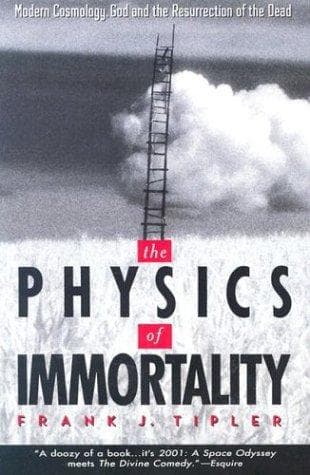
The Physics of Immortality
فيزياء الخلود
La Physique de l'immortalité
Editorial summary
Frank J. Tipler's The Physics of Immortality presents a remarkable synthesis of physics and theology, arguing that the laws of physics not only permit but necessitate the existence of God and eternal life. Drawing from quantum mechanics, general relativity, and computational theory, Tipler constructs what he terms the Omega Point Theory, proposing that the universe's evolution toward a final singularity constitutes both a physical and theological culmination.
Central to Tipler's argument is the claim that life and intelligence must eventually engulf the entire universe to prevent its heat death. He posits that as the universe approaches its final collapse, computational capacity will become infinite, allowing for the resurrection of all beings who have ever lived as emulations within this cosmic computer. This Omega Point, he argues, satisfies the traditional attributes of God: omniscience, omnipotence, and omnipresence. Tipler explicitly identifies this physical entity with the God of Judeo-Christian tradition, arguing that his theory validates core religious doctrines including resurrection, eternal life, and divine judgment through purely physical mechanisms.
Methodologically, Tipler employs mathematical physics and cosmological modeling while engaging extensively with theological literature from Aquinas to Pannenberg. He positions his work against both scientific materialism that excludes religious possibilities and traditional theology that remains disconnected from empirical science. His approach challenges the conventional boundaries between physics and metaphysics, insisting that eschatology belongs within the domain of physical science.
The work's significance lies in its audacious attempt to derive theology from physics, reversing the historical relationship between these disciplines. Tipler's argument that immortality is not merely compatible with but required by physical law represents a unique position in science-religion dialogue. His technical appendices provide rigorous mathematical foundations, while the main text addresses broader philosophical implications.
Critics have challenged both Tipler's physics and his theological interpretations, questioning whether his cosmological assumptions remain viable given subsequent empirical discoveries about cosmic acceleration. Nevertheless, his work remains influential as a systematic attempt to ground religious hope in scientific rationality. The Physics of Immortality exemplifies a distinctive form of scientific theology that neither compartmentalizes science and religion nor reduces one to the other, instead proposing their ultimate convergence at the universe's final boundary.
Argument formulations engaged
Related works
Tipler, Frank J. (1994). The Physics of Immortality. Anchor.
@book{the-physics-of-immortality-1994,
  author    = {Tipler, Frank J.},
  title     = {The Physics of Immortality},
  year      = {1994},
  publisher = {Anchor},
  url       = {https://god-database.com/en/works/the-physics-of-immortality-1994}
}