
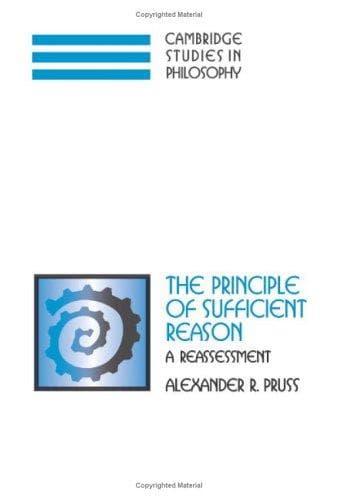
The Principle of Sufficient Reason: A Reassessment
مبدأ السبب الكافي: إعادة تقييم
Le Principe de raison suffisante : Une réévaluation
Editorial summary
This monograph presents a comprehensive defense of the Principle of Sufficient Reason (PSR), which states that every contingent fact has an explanation. Pruss addresses the principle's role in arguments for God's existence, particularly the cosmological argument, while engaging with longstanding philosophical objections that have marginalized PSR since the Enlightenment.
The work systematically examines various formulations of PSR, from strong versions claiming necessary explanations for all facts to weaker variants requiring only possible explanations. Pruss defends a moderate version asserting that every contingent proposition possibly has an explanation. This formulation avoids traditional pitfalls while maintaining sufficient strength for natural theology. The author argues that PSR reflects deep intuitions about rationality and intelligibility, suggesting that rejecting it leads to unacceptable skepticism about causation and inductive reasoning.
Central to the analysis is addressing the modal fatalism objection, which claims PSR entails that all truths are necessary. Pruss employs sophisticated work in modal logic and free will theory to demonstrate that PSR remains compatible with contingency and libertarian freedom. He argues that self-explanatory actions and agent causation can satisfy PSR's demands without eliminating genuine contingency. The treatment draws on recent developments in the metaphysics of modality, including insights from David Lewis and Robert Adams.
The monograph engages extensively with Peter van Inwagen's influential critique that PSR generates paradoxes when applied to propositions about the totality of contingent facts. Pruss develops novel solutions involving restrictions on property formation and careful attention to the logic of explanation. He demonstrates that properly formulated, PSR avoids these paradoxes while retaining its philosophical and theological utility.
The work's significance extends beyond technical metaphysics to natural theology. Pruss shows how his defended version of PSR underwrites a cogent cosmological argument for a necessary being, while acknowledging this falls short of establishing classical theism's full claims. He examines PSR's role in design arguments and its relationship to scientific explanation, arguing that scientific practice implicitly assumes PSR's truth.
Through rigorous analytical philosophy, Pruss rehabilitates a principle many considered philosophically defunct. His work represents a major contribution to debates about explanation, modality, and rational theology, demonstrating that PSR remains philosophically viable despite centuries of criticism. The monograph reestablishes PSR as a serious option in contemporary metaphysics and philosophy of religion.
Argument formulations engaged
Related works
Pruss, Alexander (2006). The Principle of Sufficient Reason: A Reassessment. Cambridge University Press.
@book{the-principle-of-sufficient-reason-a-rea,
  author    = {Pruss, Alexander},
  title     = {The Principle of Sufficient Reason: A Reassessment},
  year      = {2006},
  publisher = {Cambridge University Press},
  url       = {https://god-database.com/en/works/the-principle-of-sufficient-reason-a-reassessment-2006}
}