
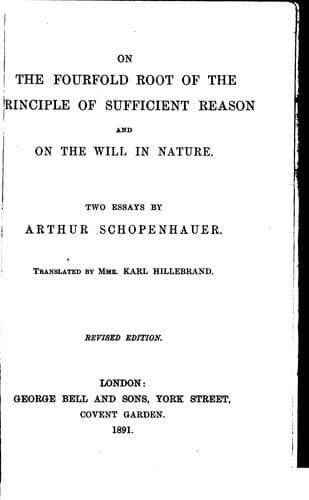
On the Fourfold Root of the Principle of Sufficient Reason
في الجذر الرباعي لمبدأ العلة الكافية
De la quadruple racine du principe de raison suffisante
Editorial summary
Schopenhauer's doctoral dissertation establishes the epistemological foundation for his later philosophical system while offering a rigorous critique of traditional metaphysical approaches to proving God's existence. The work systematically examines the principle of sufficient reason, which states that everything must have a reason or cause, dividing it into four distinct roots: becoming (causality in the physical world), knowing (logical grounds), being (mathematical necessity), and acting (motivation in human behavior).
This fourfold division serves as Schopenhauer's framework for demonstrating the limitations of human cognition and the illegitimate extension of causal reasoning beyond empirical boundaries. He argues that previous philosophers, particularly those in the rationalist tradition, erroneously apply the principle of sufficient reason beyond its proper domain when attempting cosmological or ontological proofs for God's existence. The work specifically targets the conflation of different forms of necessity and causation that undergird classical theistic arguments.
Central to Schopenhauer's critique is his distinction between phenomena (appearances subject to the principle) and noumena (things-in-themselves beyond it). He contends that God, as traditionally conceived, would necessarily transcend phenomenal reality and therefore cannot be reached through any application of the principle of sufficient reason. This epistemological boundary decisively undermines rational theology's pretensions to demonstrate divine existence through logical necessity or causal inference.
The monograph's significance for subsequent philosophy of religion lies in its systematic restriction of metaphysical speculation. By carefully delineating what can and cannot be known through the principle of sufficient reason, Schopenhauer provides tools later employed by both religious critics and defenders. His influence extends through Nietzsche to contemporary discussions about the limits of natural theology and the coherence of the God concept itself.
While not explicitly atheistic in tone, the work's implications are profoundly skeptical regarding rational approaches to God. Schopenhauer demonstrates that the very cognitive faculties believers invoke to prove God's existence are structurally incapable of reaching beyond empirical reality to any transcendent being. This epistemological critique proved more devastating to rational theology than direct atheistic polemics, as it undermines the entire enterprise of proving God's existence through reason rather than merely disputing specific arguments.
Argument formulations engaged
Related works
Schopenhauer, Arthur (1813). On the Fourfold Root of the Principle of Sufficient Reason.
@book{on-the-fourfold-root-of-the-principle-of,
  author    = {Schopenhauer, Arthur},
  title     = {On the Fourfold Root of the Principle of Sufficient Reason},
  year      = {1813},
  url       = {https://god-database.com/en/works/on-the-fourfold-root-of-the-principle-of-sufficient-reason-1813}
}