
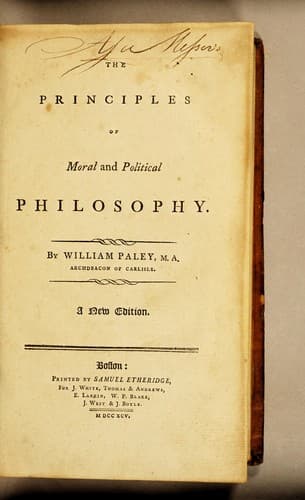
The Principles of Moral and Political Philosophy
مبادئ الفلسفة الأخلاقية والسياسية
Les Principes de philosophie morale et politique
Editorial summary
William Paley's The Principles of Moral and Political Philosophy (1785) stands as a cornerstone of eighteenth-century natural theology and utilitarian ethics, developing a sophisticated defense of theistic morality that would profoundly influence both religious apologetics and moral philosophy. The work systematically demonstrates how belief in God provides the necessary foundation for moral obligation and social order, establishing arguments that would shape theological discourse well into the nineteenth century.
Paley constructs his moral philosophy on explicitly theistic grounds, arguing that genuine moral obligation requires divine command backed by eternal sanctions. He contends that while human reason can discern what promotes general happiness, only God's will, expressed through scripture and nature, creates binding moral duties. This theological utilitarianism differs markedly from secular versions by grounding the principle of utility itself in divine benevolence. Paley maintains that God desires human happiness and has structured both natural and moral laws to achieve this end.
The work's political philosophy extends these theological premises into social theory. Paley argues that civil government derives its authority ultimately from God, though mediated through social contract and practical necessity. He defends existing social hierarchies and property arrangements as divinely sanctioned means of promoting general welfare, while acknowledging the need for benevolence and charity to temper inequality. This conservative theological politics positions itself against both radical democratic theories and purely secular accounts of political authority.
Methodologically, Paley combines empirical observation with theological reasoning, examining human nature and social institutions to demonstrate their divine design. He frequently employs analogical arguments, drawing parallels between natural and moral orders to illustrate God's consistent benevolence. This approach anticipates his later Natural Theology (1802) while focusing specifically on ethical and political questions.
The work's significance lies in its comprehensive integration of theistic belief with practical ethics and politics. Against David Hume's skepticism about deriving ought from is, Paley argues that divine command bridges this gap. Against purely secular moralists, he insists that without God and immortality, moral obligation reduces to mere prudence. His influence extended through Victorian Christianity and early utilitarian thought, with John Stuart Mill explicitly engaging and critiquing Paley's theological utilitarianism. The work remains essential for understanding how Enlightenment thinkers synthesized rational ethics with traditional theistic commitments, providing a systematic alternative to both religious voluntarism and secular naturalism.
Argument formulations engaged
Related works
Paley, William (1785). The Principles of Moral and Political Philosophy. R. Faulder.
@book{the-principles-of-moral-and-political-ph,
  author    = {Paley, William},
  title     = {The Principles of Moral and Political Philosophy},
  year      = {1785},
  publisher = {R. Faulder},
  url       = {https://god-database.com/en/works/the-principles-of-moral-and-political-philosophy-1785}
}