
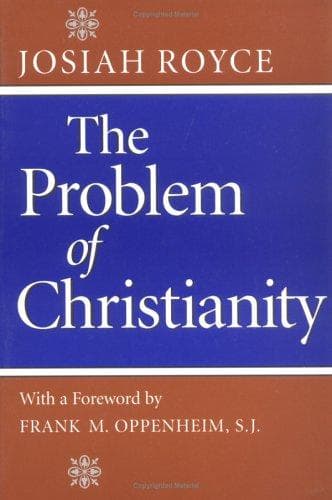
The Problem of Christianity
مشكلة المسيحية
Le Problème du christianisme
Editorial summary
Royce's The Problem of Christianity presents a sophisticated philosophical defense of Christianity that moves beyond traditional apologetics to offer a metaphysical interpretation of Christian doctrine grounded in his philosophy of loyalty and community. Writing against the backdrop of early twentieth-century religious skepticism and liberal Protestant theology, Royce develops an idealist reading of Christianity that attempts to preserve its essential truth while making it intellectually credible to modern minds.
The work centers on what Royce identifies as the three fundamental Christian ideas: the church as the Beloved Community, the moral burden of human existence, and the atoning work that creates genuine community. Rather than defending supernatural claims or biblical literalism, Royce argues that Christianity's core insight concerns the nature of human community and the conditions for its authentic realization. He contends that the Christian doctrine of salvation addresses a genuine philosophical problem: how isolated individuals can achieve real communion and shared meaning despite the barriers of finitude and moral failure.
Royce's method draws heavily on his earlier work in logic and metaphysics, particularly his theory of interpretation and his absolute idealism. He argues that the religious community functions as a spiritual interpretation of reality that transcends individual perspectives while incorporating them into a higher unity. This philosophical framework allows him to reinterpret traditional doctrines like original sin and atonement as symbolic expressions of universal human experiences rather than historical events requiring literal belief.
The text engages critically with both religious conservatives who insist on doctrinal orthodoxy and secular critics who dismiss Christianity as obsolete superstition. Against William James's individualistic approach to religious experience, Royce emphasizes the essentially communal nature of religious truth. He also challenges the historical criticism of scholars like David Friedrich Strauss by arguing that Christianity's value lies not in its historical accuracy but in its disclosure of eternal truths about human nature and community.
Royce's contribution to the God debate lies in his attempt to preserve theistic meaning within a thoroughly philosophical framework. While he maintains that Christianity reveals genuine metaphysical truth about the divine nature of community and the absolute, his God is ultimately the Absolute Spirit of idealist philosophy rather than the personal deity of traditional theism. This philosophical reconstruction of Christianity offers a middle path between reductive naturalism and naive supernaturalism, though critics question whether his idealist metaphysics can bear the weight of authentic religious commitment.
Argument formulations engaged
Related works
Royce, Josiah (1913). The Problem of Christianity.
@book{the-problem-of-christianity-1913,
  author    = {Royce, Josiah},
  title     = {The Problem of Christianity},
  year      = {1913},
  url       = {https://god-database.com/en/works/the-problem-of-christianity-1913}
}