
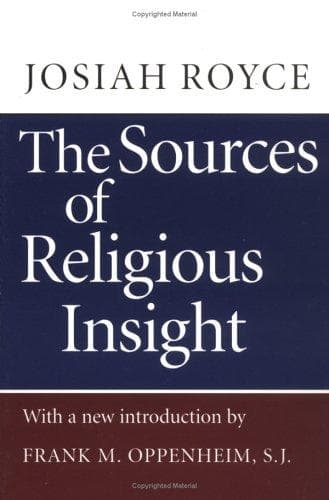
The Sources of Religious Insight
مصادر البصيرة الدينية
Les Sources de l'intuition religieuse
Editorial summary
This monograph represents Josiah Royce's mature philosophical engagement with religious experience and its epistemological foundations. Delivered originally as the Bross Lectures at Lake Forest College in 1911, the work systematically examines how human beings come to possess genuine religious knowledge and what validates such knowledge claims. Royce, writing as an absolute idealist deeply influenced by both German philosophy and American pragmatism, seeks to establish a middle path between dogmatic theology and reductive naturalism.
The text identifies seven primary sources from which religious insight emerges: individual experience, social experience, reason, will, sorrow, unity, and the invisible church. Royce argues that authentic religious knowledge cannot derive from any single source in isolation but requires a synthetic integration of all human faculties and communal verification. He particularly emphasizes the social dimension of religious truth, contending that individual mystical experiences, while potentially valuable, require interpretation through shared symbolic systems and community validation to achieve genuine insight.
Against the psychological reductionism prevalent in early twentieth-century religious studies, Royce maintains that religious experience points to metaphysical realities that transcend purely subjective states. He critiques both William James's individualistic approach to religious experience and the orthodox Christian reliance on external authority, proposing instead that religious truth emerges through a dialectical process involving personal experience, rational reflection, and communal interpretation. The work notably develops Royce's concept of the "Beloved Community" as the ultimate source and goal of religious insight, wherein individual seekers participate in a universal spiritual reality through concrete social relationships.
Royce's method combines phenomenological description with idealist metaphysics, examining how religious consciousness develops while maintaining that such development reveals objective spiritual truths. He argues that suffering and moral struggle serve as crucial catalysts for religious insight, not merely as psychological phenomena but as encounters with the fundamental structure of reality itself. The monograph contributes to early twentieth-century debates about religious epistemology by defending a philosophically sophisticated theism that acknowledges the validity of religious experience while subjecting it to rational and communal criteria. This work significantly influenced subsequent American religious thought, particularly regarding the social nature of religious truth and the relationship between individual experience and corporate spiritual life.
Argument formulations engaged
Related works
Royce, Josiah (1912). The Sources of Religious Insight. University of Chicago Press.
@book{the-sources-of-religious-insight-1912,
  author    = {Royce, Josiah},
  title     = {The Sources of Religious Insight},
  year      = {1912},
  publisher = {University of Chicago Press},
  url       = {https://god-database.com/en/works/the-sources-of-religious-insight-1912}
}