
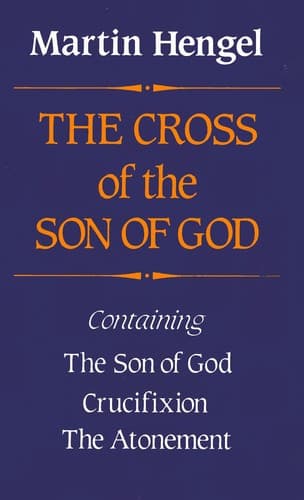
The Son of God: The Origin of Christology and the History of Jewish-Hellenistic Religion
ابن الله: أصل علم المسيح وتاريخ الديانة اليهودية الهلنستية
Le Fils de Dieu : L'origine de la christologie et l'histoire de la religion judéo-hellénistique
Editorial summary
This groundbreaking monograph examines the rapid development of early Christian beliefs about Jesus as divine Son of God, challenging prevailing assumptions about the pace and sources of christological evolution. Hengel argues that the highest christological titles and concepts emerged not gradually over decades but explosively within the first two decades after the crucifixion, primarily within Jewish rather than Hellenistic contexts.
The work systematically demonstrates that titles such as "Son of God," far from being late Hellenistic importations, possessed deep roots in Jewish messianic tradition. Hengel traces these concepts through Second Temple literature, showing how Jewish apocalyptic and wisdom traditions provided the conceptual framework for understanding Jesus's divine status. He argues that the early Jerusalem community, rather than later Gentile churches, generated the crucial christological innovations that would define Christian theology.
Methodologically, Hengel employs rigorous historical-critical analysis of texts, combining detailed philological work with broader history-of-religions comparison. He examines Jewish sources including Qumran texts, Philo, and rabbinic literature alongside early Christian writings to reconstruct the intellectual milieu of primitive Christianity. This approach directly challenges the dominant Bultmannian school, which posited a sharp discontinuity between Palestinian Jewish Christianity and Hellenistic developments.
The monograph's central contribution lies in compressing the timeline of christological development and relocating its geographic and cultural origin. By demonstrating that exalted claims about Jesus emerged immediately in Jewish contexts, Hengel undermines theories requiring extended Hellenistic influence to explain divine attribution. He shows that Jewish monotheism, rather than excluding such developments, actually provided the categories through which Jesus's disciples interpreted his significance.
Hengel's work revolutionizes understanding of how Christianity emerged as a distinct religion making extraordinary claims about God's self-revelation in Jesus. By establishing the Jewish matrix of high Christology, he demonstrates that the deification of Jesus represents not a betrayal of Jewish monotheism but a radical reinterpretation from within. The study thus illuminates fundamental questions about how new religious movements reconceptualize divinity while maintaining continuity with their traditions. His arguments have profoundly influenced subsequent scholarship on Christian origins, the parting of ways between Judaism and Christianity, and the development of Trinitarian theology.
Argument formulations engaged
Related works
Hengel, Martin (1976). The Son of God: The Origin of Christology and the History of Jewish-Hellenistic Religion.
@book{the-son-of-god-the-origin-of-christology,
  author    = {Hengel, Martin},
  title     = {The Son of God: The Origin of Christology and the History of Jewish-Hellenistic Religion},
  year      = {1976},
  url       = {https://god-database.com/en/works/the-son-of-god-the-origin-of-christology-and-the-history-of-jewish-hellenistic-religion-1976}
}