
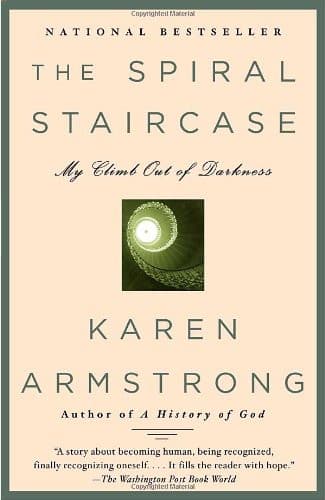
The Spiral Staircase: My Climb Out of Darkness
الدرج الحلزوني: صعودي من الظلام
L'Escalier en spirale : Mon ascension hors des ténèbres
Editorial summary
The Spiral Staircase recounts Karen Armstrong's journey from failed nun to acclaimed scholar of religion, weaving memoir with theological reflection. The work traces her struggle with epilepsy, depression, and religious doubt following her departure from convent life in 1969, ultimately chronicling her rediscovery of the sacred through academic study rather than traditional faith. Armstrong's narrative contributes to debates about God by proposing that religious meaning emerges through intellectual engagement and compassionate practice rather than doctrinal belief or mystical experience.
Armstrong positions herself against both conventional theism and reductive secularism. She critiques her convent's emphasis on self-abnegation and supernatural encounter, arguing such approaches damaged rather than nurtured spiritual development. Equally, she challenges secular dismissals of religion as mere neurosis or delusion. Her epileptic hallucinations, initially mistaken for mystical visions, become a lens for examining how physiological and psychological factors intersect with religious experience without wholly explaining it away.
The work's method combines autobiography with comparative religious analysis. Armstrong draws on her scholarly expertise to contextualize her personal journey within broader patterns of spiritual seeking. She references mystics like Denys the Areopagite and contemporary thinkers like Rudolf Otto to frame her evolving understanding of the sacred. This approach allows her to articulate a vision of God as encountered through disciplined study and ethical action rather than supernatural intervention.
Central to Armstrong's argument is the concept of apophatic theology—the via negativa that defines God through what cannot be said rather than positive assertions. She suggests this approach, emphasizing divine unknowability, offers a middle path between literalist belief and atheistic rejection. Her rediscovery of Judaism through academic research exemplifies this perspective: finding profound meaning in tradition's intellectual and ethical dimensions without requiring credal affirmation.
The work's significance lies in modeling an alternative religious stance for contemporary seekers. Armstrong demonstrates how rigorous scholarship can itself become spiritual practice, and how compassion—what she identifies as the core of authentic religion—transcends doctrinal boundaries. Her journey from failed mysticism through academic achievement to renewed spiritual engagement suggests that encounters with the sacred adapt to individual temperament and cultural context. This autobiographical theology contributes a lived example of religion reimagined for those who find traditional theism intellectually untenable yet remain drawn to transcendent meaning.
Argument formulations engaged
Related works
Armstrong, Karen (2004). The Spiral Staircase: My Climb Out of Darkness. Knopf.
@book{the-spiral-staircase-my-climb-out-of-dar,
  author    = {Armstrong, Karen},
  title     = {The Spiral Staircase: My Climb Out of Darkness},
  year      = {2004},
  publisher = {Knopf},
  url       = {https://god-database.com/en/works/the-spiral-staircase-my-climb-out-of-darkness-2004}
}