
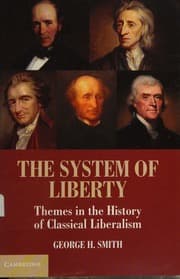
The System of Liberty: Themes in the History of Classical Liberalism
نظام الحرية: مواضيع في تاريخ الليبرالية الكلاسيكية
Le Système de la Liberté : Thèmes dans l'Histoire du Libéralisme Classique
Editorial summary
This comprehensive historical study examines the philosophical foundations and evolution of classical liberal thought from the seventeenth through nineteenth centuries. Smith traces how liberal theorists developed systematic arguments for individual liberty, limited government, and spontaneous social order while grappling with fundamental questions about human nature, social cooperation, and political authority.
The work explores how early liberal thinkers confronted the dominant religious and political orthodoxies of their time. Smith analyzes how figures like John Locke challenged divine right theory and developed naturalistic accounts of rights and government based on reason rather than revelation. He examines how Scottish Enlightenment philosophers like David Hume and Adam Smith articulated theories of spontaneous order that explained complex social phenomena without recourse to divine design or centralized planning. The author demonstrates how these thinkers employed methodological individualism and empirical analysis to understand society as emerging from human action rather than supernatural intervention.
Smith's intellectual history reveals how classical liberals progressively secularized political philosophy. He shows how liberal theorists moved from Locke's deistic framework, which still grounded natural rights in divine creation, toward fully secular justifications for liberty based on utility, human nature, or rational self-interest. The work examines how nineteenth-century liberals like John Stuart Mill developed comprehensive philosophies of individual autonomy that relegated religious belief to the private sphere while defending tolerance and pluralism in public life.
The monograph contributes to understanding the relationship between liberalism and secularization in Western thought. Smith demonstrates how liberal philosophy provided intellectual tools for limiting religious authority in political life while protecting religious freedom as a private right. He analyzes how liberal thinkers developed theories of social order that dispensed with theological explanations, instead grounding political legitimacy in consent, utility, or natural rights discoverable through reason. The work illuminates how classical liberalism's emphasis on individual judgment, empirical method, and rational critique created conceptual space for questioning traditional religious authority while establishing new foundations for social cooperation. This historical analysis helps explain liberalism's complex relationship with religious belief, showing how the tradition simultaneously challenged theological politics while defending religious liberty as a fundamental right.
Argument formulations engaged
Related works
Smith, George H. (2013). The System of Liberty: Themes in the History of Classical Liberalism. Cambridge University Press.
@book{the-system-of-liberty-themes-in-the-hist,
  author    = {Smith, George H.},
  title     = {The System of Liberty: Themes in the History of Classical Liberalism},
  year      = {2013},
  publisher = {Cambridge University Press},
  url       = {https://god-database.com/en/works/the-system-of-liberty-themes-in-the-history-of-classical-liberalism-2013}
}