
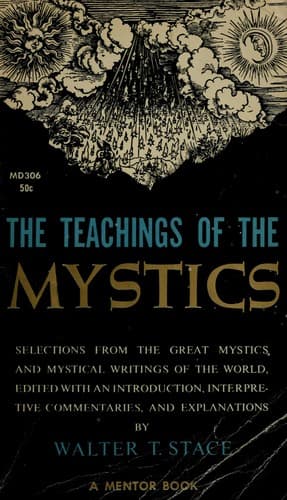
The Teachings of the Mystics
تعاليم الصوفيين
Les Enseignements des Mystiques
Editorial summary
This influential anthology systematically presents mystical testimonies from diverse religious traditions, examining their philosophical implications for understanding religious experience and the nature of ultimate reality. Stace organizes mystical writings from Christian, Islamic, Hindu, Buddhist, and Jewish sources, demonstrating remarkable phenomenological similarities across cultural boundaries while analyzing their metaphysical significance.
The volume distinguishes between two fundamental types of mystical experience: extrovertive mysticism, which perceives unity within multiplicity in the external world, and introvertive mysticism, characterized by contentless consciousness achieving undifferentiated unity. Stace argues that despite doctrinal variations, mystics consistently report encounters with an ineffable, timeless reality transcending subject-object distinctions. This experiential core remains constant whether interpreted through theistic, monistic, or non-theistic frameworks.
Central to Stace's analysis is the relationship between mystical experience and religious doctrine. He contends that while interpretative frameworks vary culturally, the underlying experiences exhibit universal characteristics: dissolution of ego boundaries, apprehension of paradoxical unity, and awareness beyond discursive thought. The work challenges both dismissive psychological reductionism and uncritical religious apologetics, proposing instead that mystical experiences constitute genuine epistemological encounters deserving philosophical investigation.
The collection engages critically with empiricist objections to mystical knowledge claims. Against logical positivist dismissals of mystical language as meaningless, Stace demonstrates how paradoxical expressions arise necessarily from experiences transcending ordinary categorical thinking. He examines how mystics employ negative theology and symbolic discourse to communicate inherently ineffable insights, arguing that such strategies represent sophisticated responses to genuine experiential realities rather than mere linguistic confusion.
Stace's editorial framework influences subsequent debates about religious pluralism and perennialism. His thesis that diverse mystical traditions share common experiential cores while differing in interpretation anticipates later discussions about universal religious experiences versus culturally constructed meanings. The work provides essential primary sources for scholars examining whether mystical experiences offer evidence for transcendent reality or merely reflect neurological states interpreted through religious frameworks.
The volume's lasting contribution lies in its rigorous phenomenological approach to mystical testimony, treating these accounts as data requiring explanation rather than dismissing them as delusion or accepting them as unquestionable revelation. This methodological balance establishes parameters for ongoing philosophical discussions about consciousness, religious experience, and the limits of empirical knowledge in addressing questions about ultimate reality and the divine.
Argument formulations engaged
Related works
Stace, W. T. (1960). The Teachings of the Mystics. New American Library.
@book{the-teachings-of-the-mystics-1960,
  author    = {Stace, W. T.},
  title     = {The Teachings of the Mystics},
  year      = {1960},
  publisher = {New American Library},
  url       = {https://god-database.com/en/works/the-teachings-of-the-mystics-1960}
}