
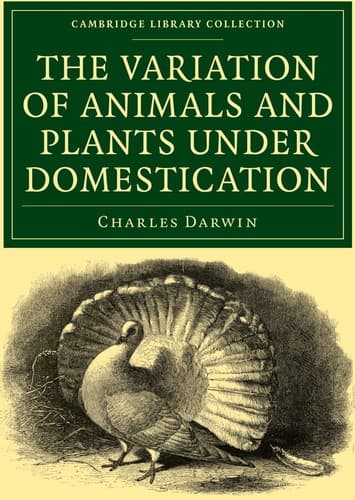
The Variation of Animals and Plants under Domestication
تنوع الحيوانات والنباتات تحت التدجين
La Variation des Animaux et des Plantes sous la Domestication
Editorial summary
This monograph extends Darwin's evolutionary theory to the realm of artificial selection, examining how human intervention shapes the development of domesticated species. While not explicitly theological, the work carries profound implications for natural theology and design arguments that dominated Victorian thought. Darwin meticulously documents variations in domesticated animals from pigeons to cattle, and cultivated plants from cereals to ornamental flowers, demonstrating how selective breeding produces dramatic morphological changes within relatively short timeframes.
The work's significance for the God debate lies in its implicit challenge to William Paley's watchmaker analogy and the broader argument from design. By showing how conscious human selection produces apparent "design" in domestic varieties, Darwin suggests a mechanism whereby unconscious natural selection could produce the appearance of design in wild species. This undermines the inference from biological complexity to divine intelligence that formed a cornerstone of nineteenth-century natural theology.
Darwin employs an exhaustive empirical method, compiling observations from breeders, horticulturalists, and his own extensive experiments. He examines reversion, inheritance patterns, and the limits of variation, always with an eye toward explaining how selection operates on available variation. His discussion of pangenesis, though ultimately incorrect, represents an attempt to explain the material basis of inheritance without recourse to special creation.
The intellectual context involves ongoing debates between special creationists, who maintained that each species reflects a separate divine act, and those accepting limited transmutation within divinely established types. Darwin's work suggests no such boundaries exist, implying that all organic diversity could arise through natural processes without divine intervention at the species level.
Particularly significant is Darwin's treatment of human-directed change as analogous to natural processes. This methodology implicitly rejects the categorical distinction between human agency and natural causation that many theologians maintained. If human selection operates through the same mechanisms as natural selection, then appeals to divine selection become explanatorily superfluous.
The monograph thus contributes to secularizing biological explanation by demonstrating how complex, apparently designed features arise through comprehensible material processes. While Darwin carefully avoids explicit theological commentary, his systematic demonstration that domestic varieties arise through selection rather than special creation extends the domain of naturalistic explanation, reducing the explanatory scope traditionally assigned to divine action in the organic world.
Argument formulations engaged
Related works
Darwin, Charles (1868). The Variation of Animals and Plants under Domestication.
@book{the-variation-of-animals-and-plants-unde,
  author    = {Darwin, Charles},
  title     = {The Variation of Animals and Plants under Domestication},
  year      = {1868},
  url       = {https://god-database.com/en/works/the-variation-of-animals-and-plants-under-domestication-1868}
}