
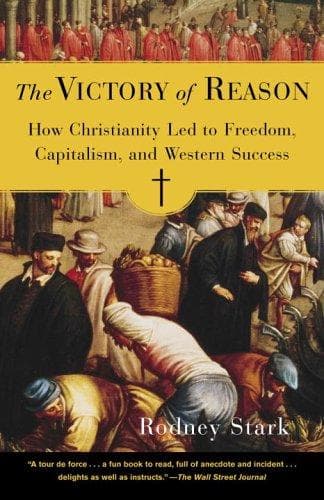
The Victory of Reason
انتصار العقل
La Victoire de la Raison
Editorial summary
Rodney Stark's The Victory of Reason advances a provocative thesis that Christianity, rather than hindering intellectual progress, served as the essential catalyst for the rise of Western science, democracy, and capitalism. Writing against prevailing narratives that credit these achievements to secular Enlightenment forces breaking free from religious constraints, Stark argues that Christian theology uniquely provided the intellectual foundation necessary for sustained rational inquiry and economic development.
The work systematically challenges conventional historiography that portrays medieval Christianity as antagonistic to reason. Stark contends that Christianity's conception of a rational God who created an orderly universe governed by discoverable laws motivated believers to pursue systematic investigation of nature. This theological framework, he argues, distinguished Christianity from other religious traditions that viewed the cosmos as either chaotic or cyclical. The author traces how medieval monasteries and universities, far from suppressing inquiry, fostered environments where rational discourse flourished, leading directly to scientific breakthroughs.
Stark's analysis extends beyond intellectual history to economic development. He maintains that Christian theology's emphasis on moral equality and individual dignity created conditions favorable to capitalism's emergence. Medieval theological discussions about just price, property rights, and the morality of profit, rather than representing obstacles to economic progress, established ethical frameworks that enabled market economies to develop. The author contrasts this with other civilizations where, despite technological advantages, similar economic systems failed to emerge due to different theological assumptions.
The monograph employs comparative historical analysis, examining why science and capitalism arose in Christian Europe rather than in China, Islam, or ancient Greece. Stark attributes this divergence not to material conditions but to theological differences, particularly Christianity's linear view of time, belief in progress, and conviction that God's creation operates according to rational principles accessible to human understanding.
While primarily historical in approach, The Victory of Reason engages contemporary debates about secularization and the relationship between faith and reason. Stark challenges both secular triumphalists who view religion as inherently irrational and religious fundamentalists who reject reason's validity. His work suggests that the perceived conflict between faith and reason represents a false dichotomy, arguing instead that Christian theism historically provided the necessary metaphysical assumptions for rational inquiry's success. This controversial thesis positions Christianity not as reason's opponent but as its historical progenitor and philosophical guarantor.
Argument formulations engaged
Stark, Rodney (2005). The Victory of Reason. Random House Trade Paperbacks.
@book{the-victory-of-reason-2005,
  author    = {Stark, Rodney},
  title     = {The Victory of Reason},
  year      = {2005},
  publisher = {Random House Trade Paperbacks},
  url       = {https://god-database.com/en/works/the-victory-of-reason-2005}
}