
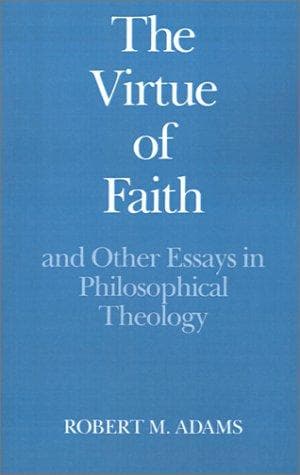
The Virtue of Faith and Other Essays in Philosophical Theology
فضيلة الإيمان ومقالات أخرى في اللاهوت الفلسفي
La Vertu de la Foi et Autres Essais de Théologie Philosophique
Editorial summary
Adams presents a sustained defense of religious faith as intellectually respectable and morally praiseworthy, challenging the widespread philosophical assumption that faith necessarily involves epistemic irresponsibility. The collection's central thesis holds that faith can constitute a virtue when properly understood and practiced, even in the absence of conclusive evidence for theistic claims.
The title essay establishes Adams's core argument that faith need not violate epistemic duties. He distinguishes between believing against overwhelming counter-evidence (which he concedes would be irrational) and maintaining belief in the absence of decisive proof either way. Adams contends that in conditions of genuine epistemic ambiguity regarding God's existence, choosing to believe can express morally admirable qualities like trust, hope, and loyalty. This move directly challenges evidentialist critics like W.K. Clifford who argue that belief without sufficient evidence is always wrong.
Adams develops his position through careful engagement with both historical and contemporary sources. He draws on Kierkegaard's notion of faith as passionate commitment while rejecting fideistic extremes, and incorporates insights from Reformed epistemology without fully endorsing its critique of classical foundationalism. His approach is notably moderate, acknowledging the reasonableness of agnosticism while defending the equal reasonableness of theistic commitment under conditions of uncertainty.
The collection's other essays explore related themes in philosophical theology. Adams examines the problem of evil, arguing that theists can coherently maintain belief in divine goodness despite suffering. He analyzes the concept of divine command ethics, defending a sophisticated version that avoids standard objections about arbitrariness. Throughout, Adams employs rigorous analytic methods while remaining sensitive to the existential dimensions of religious life.
The work's significance lies in its philosophical rehabilitation of faith within mainstream analytic philosophy. Writing during a period when philosophy of religion was regaining respectability in Anglo-American departments, Adams helps establish that religious commitment need not require intellectual sacrifice. His nuanced position offers a middle path between dogmatic certainty and wholesale rejection of religious belief, demonstrating how faith might coexist with philosophical sophistication. The collection thus provides crucial resources for theists seeking to defend their beliefs against charges of irrationality while honestly acknowledging the absence of demonstrative proofs.
Argument formulations engaged
Related works
Adams, Robert Merrihew (1987). The Virtue of Faith and Other Essays in Philosophical Theology. Oxford University Press.
@book{the-virtue-of-faith-and-other-essays-in-,
  author    = {Adams, Robert Merrihew},
  title     = {The Virtue of Faith and Other Essays in Philosophical Theology},
  year      = {1987},
  publisher = {Oxford University Press},
  url       = {https://god-database.com/en/works/the-virtue-of-faith-and-other-essays-in-philosophical-theology-1987}
}