
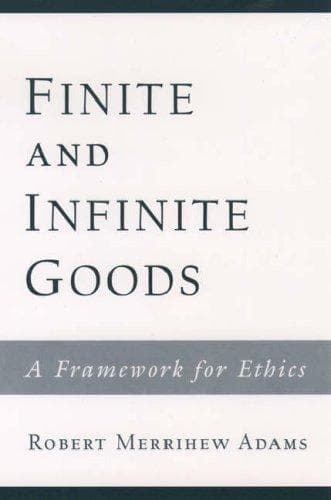
Finite and Infinite Goods: A Framework for Ethics
الخيرات المحدودة واللامحدودة: إطار للأخلاق
Biens finis et infinis : Un cadre pour l'éthique
Editorial summary
Adams presents a sophisticated ethical framework that grounds moral value in relation to the infinite Good, which he identifies with God. The work develops a theistic metaethics that challenges both secular moral realism and divine command theory, proposing instead that finite goods derive their value through resemblance to or participation in divine goodness.
The monograph's central thesis holds that excellence consists in faithfulness to the Good itself, understood as a transcendent, personal reality. Adams argues that finite things possess value insofar as they image or reflect aspects of the infinite Good. This Platonic-Augustinian framework allows him to maintain moral objectivity while avoiding the arbitrariness often associated with voluntarist divine command theories. Rather than making goodness dependent on divine will alone, Adams grounds it in divine nature, though he preserves a role for divine commands in determining moral obligations.
Adams engages critically with contemporary secular ethics, particularly the neo-Humean approaches dominant in late twentieth-century moral philosophy. Against projectivist and constructivist accounts, he argues that they cannot adequately explain the categorical force of moral demands or the apparent objectivity of value judgments. His framework also addresses naturalistic moral realism, contending that purely natural properties lack the transcendent character necessary to ground the absolute claims of morality.
The work makes several distinctive contributions to philosophical theology. Adams develops a nuanced account of how religious devotion relates to moral excellence, arguing that love of the Good itself represents the highest form of ethical life. He also offers a theodicy-relevant discussion of how finite goods can exist despite their imperfection, suggesting that their partial resemblance to divine goodness suffices for genuine though limited value.
Methodologically, Adams combines careful conceptual analysis with engagement across multiple philosophical traditions. He draws on Plato, Augustine, and Aquinas while addressing contemporary analytic philosophers like Mackie, Blackburn, and Korsgaard. The work exemplifies a revival of metaphysically robust theistic ethics within analytic philosophy.
The monograph's significance extends beyond technical metaethics. By articulating how transcendent theism can ground a compelling ethical framework, Adams challenges the widespread assumption that moral philosophy must proceed independently of theology. His account demonstrates that theistic commitments can enhance rather than diminish philosophical rigor in ethics, offering resources for addressing perennial questions about moral motivation, objectivity, and the unity of the virtues.
Argument formulations engaged
Related works
Adams, Robert Merrihew (1999). Finite and Infinite Goods: A Framework for Ethics. Oxford University Press.
@book{finite-and-infinite-goods-a-framework-fo,
  author    = {Adams, Robert Merrihew},
  title     = {Finite and Infinite Goods: A Framework for Ethics},
  year      = {1999},
  publisher = {Oxford University Press},
  url       = {https://god-database.com/en/works/finite-and-infinite-goods-a-framework-for-ethics-1999}
}