
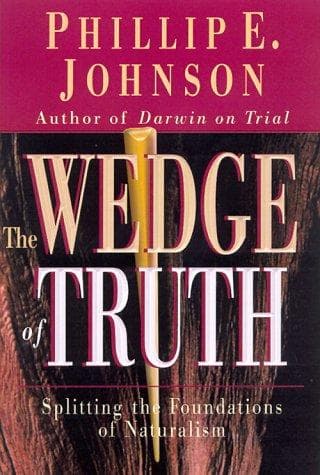
The Wedge of Truth: Splitting the Foundations of Naturalism
إسفين الحقيقة: تفكيك أسس النزعة الطبيعية
Le Coin de la Vérité : Diviser les Fondements du Naturalisme
Editorial summary
Phillip E. Johnson's The Wedge of Truth: Splitting the Foundations of Naturalism presents a sustained critique of philosophical naturalism and its dominance in contemporary scientific and intellectual discourse. As a central figure in the Intelligent Design movement, Johnson argues that naturalism functions as an unexamined philosophical commitment rather than a scientifically demonstrated truth, and that this commitment systematically excludes theistic explanations from serious consideration in academic and scientific contexts.
The work develops what Johnson terms the "wedge strategy," a metaphor for inserting critical analysis into the perceived monolith of naturalistic thinking. He contends that modern science operates under methodological naturalism, which he distinguishes from metaphysical naturalism while arguing that the former inevitably slides into the latter. Johnson challenges the assumption that scientific inquiry must proceed as if supernatural causation does not exist, suggesting this presumption prejudges fundamental questions about origins and design before empirical investigation begins.
Johnson particularly targets Darwinian evolution as the cornerstone of naturalistic ideology. He argues that evolutionary theory gains its persuasive force not from empirical evidence but from the prior philosophical commitment to naturalism that makes it the only permissible explanation. The author examines specific scientific controversies, including the Cambrian explosion and the origin of biological information, presenting them as anomalies that naturalistic evolution cannot adequately explain.
The book engages prominent defenders of naturalism, including Richard Dawkins, Stephen Jay Gould, and Daniel Dennett, analyzing their arguments as expressions of philosophical preference rather than scientific necessity. Johnson employs legal reasoning throughout, drawing on his background as a law professor to cross-examine the logic of naturalistic claims and expose what he sees as circular reasoning in evolutionary arguments.
Beyond scientific critique, Johnson addresses the cultural and moral implications of naturalism's dominance. He argues that naturalism undermines traditional moral foundations and human dignity by reducing consciousness and values to mere products of material processes. The work positions itself within broader debates about academic freedom, arguing that the exclusion of design-based explanations represents an illegitimate restriction on intellectual inquiry. Johnson's contribution lies in framing the evolution-creation controversy as fundamentally philosophical rather than purely scientific, challenging readers to recognize and question the naturalistic assumptions underlying contemporary thought.
Argument formulations engaged
Related works
Johnson, Phillip E. (2000). The Wedge of Truth: Splitting the Foundations of Naturalism. InterVarsity Press.
@book{the-wedge-of-truth-splitting-the-foundat,
  author    = {Johnson, Phillip E.},
  title     = {The Wedge of Truth: Splitting the Foundations of Naturalism},
  year      = {2000},
  publisher = {InterVarsity Press},
  url       = {https://god-database.com/en/works/the-wedge-of-truth-splitting-the-foundations-of-naturalism-2000}
}