
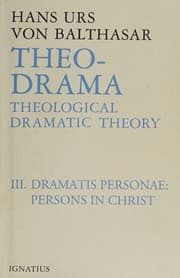
Theo-Drama: Theological Dramatic Theory
اللاهوت الدرامي: نظرية المسرح اللاهوتي
Théo-Drame : Théorie Dramatique Théologique
Editorial summary
Hans Urs von Balthasar's Theo-Drama: Theological Dramatic Theory represents a monumental contribution to twentieth-century Catholic theology through its innovative theatrical approach to understanding divine-human interaction. This five-volume work, appearing between 1973 and 1983 in German and translated into English from 1988 onwards, constitutes the second major installment of Balthasar's theological trilogy, positioned between his theological aesthetics and theological logic.
Balthasar employs dramatic categories to articulate how God reveals himself through action in history, arguing that the theatrical metaphor provides the most adequate framework for comprehending the dynamic relationship between divine freedom and human freedom. The work directly challenges both neo-scholastic approaches that reduce theology to propositional statements and existentialist theologies that minimize the objective content of revelation. Against Karl Barth's emphasis on divine sovereignty, Balthasar insists on genuine human freedom as a necessary component of the theo-dramatic action, while against Karl Rahner's transcendental method, he maintains the irreducible particularity of the Christ-event.
The author develops his argument through a sophisticated engagement with theatrical theory from Aristotle to modern dramatists, demonstrating how concepts such as role, mission, performance, and horizon illuminate theological realities. Central to his analysis is the notion that human existence possesses an inherently dramatic structure, characterized by the tension between finite freedom and infinite horizon. This dramatic tension reaches its climax in the person of Jesus Christ, whom Balthasar presents as both the supreme Actor and Author of the divine drama.
Methodologically, Balthasar combines ressourcement theology's return to patristic sources with a creative appropriation of contemporary philosophical insights, particularly from phenomenology and personalism. His approach synthesizes biblical exegesis, historical theology, and cultural analysis to construct a comprehensive vision of God's self-communication through dramatic action.
The work's significance for the God debate lies in its demonstration that divine revelation cannot be adequately understood through purely conceptual or mystical categories alone. By showing how God's being is inseparable from God's dramatic action in history, Balthasar offers a compelling alternative to both deistic conceptions of divine remoteness and pantheistic dissolutions of divine transcendence. His theo-dramatic theory provides a framework for understanding God as supremely personal while maintaining divine otherness, thereby addressing perennial tensions in Christian theological discourse about divine immanence and transcendence.
Argument formulations engaged
Related works
Balthasar, Hans Urs von (1988). Theo-Drama: Theological Dramatic Theory. Ignatius Press.
@book{theo-drama-theological-dramatic-theory-1,
  author    = {Balthasar, Hans Urs von},
  title     = {Theo-Drama: Theological Dramatic Theory},
  year      = {1988},
  publisher = {Ignatius Press},
  url       = {https://god-database.com/en/works/theo-drama-theological-dramatic-theory-1988}
}