
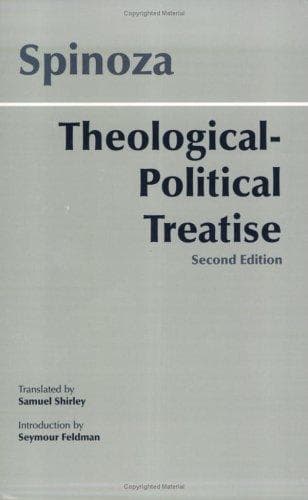
Theological-Political Treatise
رسالة في اللاهوت والسياسة
Traité Théologico-Politique
Editorial summary
Spinoza's Theological-Political Treatise represents a revolutionary intervention in seventeenth-century debates about scripture, reason, and political authority. Written during intense religious conflicts in the Dutch Republic, the work systematically dismantles traditional theological claims about biblical revelation and divine providence while proposing a naturalistic understanding of religion's origins and functions.
The treatise advances its argument through meticulous biblical criticism, demonstrating that scripture contains numerous contradictions, historical inaccuracies, and culturally specific elements that undermine claims of divine authorship. Spinoza argues that prophecy results not from supernatural communication but from particularly vivid imaginations shaped by local customs and languages. He contends that miracles, properly understood, represent merely unusual natural events that ignorant observers attribute to divine intervention. This methodological naturalism extends to his analysis of religious law, which he interprets as political legislation specific to the ancient Hebrew state rather than eternal divine commands.
Central to Spinoza's project is the radical separation of philosophy from theology. While philosophy seeks truth through reason, theology aims only at obedience and piety. This distinction allows him to argue that scripture teaches nothing about God's nature or the natural world, containing instead practical moral guidance reducible to the universal principle of loving one's neighbor. By restricting religion's domain to ethical practice, Spinoza undermines clerical authority over intellectual inquiry and political life.
The work's political implications prove equally radical. Spinoza argues that religious authorities manipulate supernatural beliefs to control populations through fear and hope. He advocates for complete freedom of thought and expression, contending that attempts to regulate belief inevitably fail and produce only hypocrisy and sedition. The sovereign should concern itself solely with external actions, leaving individuals free to think and speak according to reason.
This treatise fundamentally reshapes the God debate by replacing the personal deity of traditional theism with an impersonal nature governed by eternal laws. Spinoza's God neither intervenes in human affairs nor issues commands but exists as the infinite substance identical with nature itself. His historical-critical method anticipates later biblical scholarship, while his political theology influences subsequent arguments for religious toleration and secular governance. The work stands as a foundational text for modern critiques of revealed religion and supernatural worldviews.
Argument formulations engaged
Related works
Spinoza, Baruch (1670). Theological-Political Treatise.
@book{theological-political-treatise-1670,
  author    = {Spinoza, Baruch},
  title     = {Theological-Political Treatise},
  year      = {1670},
  url       = {https://god-database.com/en/works/theological-political-treatise-1670}
}