
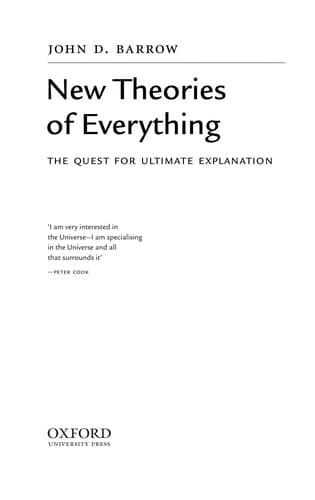
Theories of Everything: The Quest for Ultimate Explanation
نظريات كل شيء: البحث عن التفسير النهائي
Théories du Tout : La Quête de l'Explication Ultime
Editorial summary
In Theories of Everything: The Quest for Ultimate Explanation, John D. Barrow examines the scientific pursuit of a unified theory that would explain all physical phenomena, while critically analyzing the philosophical and theological implications of such a quest. Writing from his position as a theoretical physicist and mathematician, Barrow explores whether science can achieve a complete description of reality and what such completeness would mean for questions about ultimate meaning and purpose.
The work traces the historical development of unification in physics, from Newton's synthesis of terrestrial and celestial mechanics through Einstein's relativity to contemporary attempts at quantum gravity and string theory. However, Barrow distinguishes his approach from purely scientific accounts by systematically examining the limits and presuppositions of theories of everything. He argues that even the most comprehensive physical theory faces insurmountable barriers: the problem of initial conditions, the necessity of mathematical frameworks that themselves require explanation, and the emergence of complexity that resists reduction to fundamental laws.
Central to Barrow's analysis is his critique of scientific reductionism and the claim that physics alone can answer all meaningful questions. He demonstrates that theories of everything in physics are necessarily theories of everything physical, leaving unaddressed questions of consciousness, meaning, and purpose. While not explicitly advocating theism, Barrow suggests that the very intelligibility of the universe and the unreasonable effectiveness of mathematics in describing nature point toward metaphysical questions that science cannot resolve.
The work engages with both scientific triumphalists who claim physics will eventually explain everything and religious fundamentalists who reject scientific cosmology. Barrow occupies a middle position, arguing that scientific and religious discourse address complementary aspects of reality. He examines how the anthropic principle and fine-tuning observations in cosmology reopen questions about design and purpose that nineteenth-century materialism had presumed closed.
Barrow's contribution to the God debate lies in his sophisticated analysis of the explanatory limits of physical science. By demonstrating that even a complete theory of everything would leave fundamental questions unanswered, he creates intellectual space for theological reflection without undermining scientific inquiry. His work challenges both atheistic assumptions about the sufficiency of physical explanation and simplistic religious rejections of cosmological science. The monograph remains influential in discussions about the relationship between ultimate scientific theories and ultimate metaphysical questions.
Argument formulations engaged
Related works
Barrow, John D. (1991). Theories of Everything: The Quest for Ultimate Explanation. Oxford University Press.
@book{theories-of-everything-the-quest-for-ult,
  author    = {Barrow, John D.},
  title     = {Theories of Everything: The Quest for Ultimate Explanation},
  year      = {1991},
  publisher = {Oxford University Press},
  url       = {https://god-database.com/en/works/theories-of-everything-the-quest-for-ultimate-explanation-1991}
}