
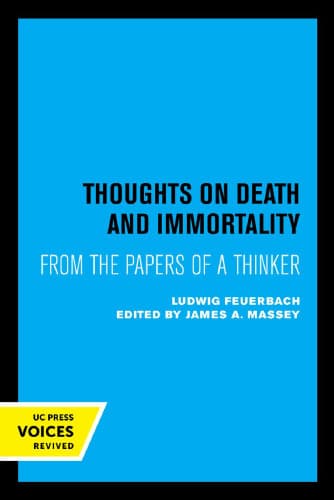
Thoughts on Death and Immortality
أفكار حول الموت والخلود
Pensées sur la Mort et l'Immortalité
Editorial summary
Feuerbach's Thoughts on Death and Immortality represents an early and provocative intervention in nineteenth-century debates about personal immortality and the nature of religious consciousness. Published anonymously in 1830, this work cost the young Hegelian philosopher his academic career due to its radical rejection of Christian doctrines of individual survival after death. The monograph demonstrates Feuerbach's emerging critique of religious belief as a projection of human desires and fears, anticipating themes that would reach full expression in his later Essence of Christianity.
The work systematically dismantles traditional arguments for personal immortality through a combination of Hegelian dialectics and empirical observation. Feuerbach argues that the belief in individual survival after death stems from human narcissism and the inability to accept finitude. He contends that consciousness depends entirely on material embodiment and that the notion of a disembodied soul continuing after death is philosophically incoherent. Drawing on Spinoza and Hegel, he proposes that true immortality consists not in personal survival but in the continuation of humanity as a species and the preservation of one's contributions to human culture and knowledge.
Central to Feuerbach's argument is his analysis of how the fear of death generates religious illusions. He examines how Christianity exploits this fear by promising eternal life, thereby alienating believers from their earthly existence and responsibilities. The work critiques both philosophical arguments for immortality, such as those found in Kant and traditional Christian apologetics, and popular religious beliefs about heaven and hell. Feuerbach particularly targets the notion that individual personality could persist without the body, arguing that this represents a fundamental misunderstanding of the nature of consciousness.
The monograph's significance extends beyond its specific arguments about immortality. It marks a crucial moment in the development of religious naturalism and anticipates later atheistic critiques of religion by Marx, Nietzsche, and Freud. Feuerbach's method of analyzing religious beliefs as projections of human needs and desires would become influential in religious studies, psychology, and anthropology. His insistence that accepting mortality is essential for authentic human existence prefigures existentialist themes in twentieth-century philosophy. The work remains relevant to contemporary debates about consciousness, personal identity, and the relationship between religious belief and human flourishing.
Argument formulations engaged
Related works
Feuerbach, Ludwig (1830). Thoughts on Death and Immortality. University of California Press.
@book{thoughts-on-death-and-immortality-1830,
  author    = {Feuerbach, Ludwig},
  title     = {Thoughts on Death and Immortality},
  year      = {1830},
  publisher = {University of California Press},
  url       = {https://god-database.com/en/works/thoughts-on-death-and-immortality-1830}
}