
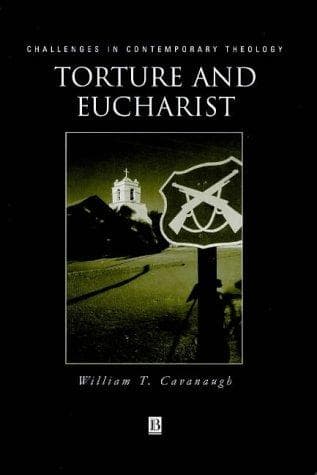
Torture and Eucharist
التعذيب والإفخارستيا
Torture et Eucharistie
Editorial summary
This provocative work examines the relationship between state violence and Christian liturgical practice, offering a theological critique of modern political sovereignty that bears significantly on debates about divine authority and human governance. Cavanaugh analyzes the military dictatorship in Chile (1973-1990) as a case study for understanding how the modern nation-state displaces religious imagination and practice, replacing divine sovereignty with political absolutism.
The monograph develops a sophisticated theological argument about the Eucharist as a counter-politics to state torture. Cavanaugh contends that torture functions as a perverse liturgy through which the state inscribes its absolute power onto human bodies, creating isolated individuals who exist only in relation to state authority. This process, he argues, represents a fundamental challenge to Christian conceptions of divine sovereignty and human community. The state's monopolization of public space and meaning-making effectively usurps God's role as the ultimate source of human identity and social bonds.
Against this backdrop, Cavanaugh presents the Eucharist as a practice that reconstitutes authentic community and resists the state's totalizing claims. Through careful analysis of liturgical theology, particularly drawing on Henri de Lubac and John Zizioulas, he argues that the Eucharist creates an alternative social body that transcends the boundaries imposed by political sovereignty. This eucharistic community embodies a different understanding of power, one rooted in divine self-gift rather than coercive violence.
The work engages critically with modern political theology, particularly Carl Schmitt's notion of sovereignty and Giorgio Agamben's analysis of bare life. Cavanaugh challenges secular assumptions about the privatization of religion, arguing that authentic Christian practice necessarily involves public, political dimensions that contest the state's claims to ultimate authority. His analysis suggests that proper understanding of divine sovereignty requires recognizing how modern political formations systematically exclude or domesticate religious imagination.
This monograph contributes to the God debate by demonstrating how political practices shape possibilities for conceiving divine action in the world. Cavanaugh's argument implies that questions about God's existence and nature cannot be separated from analysis of the social and political structures that mediate human experience. His work suggests that recovery of robust theological imagination requires critical examination of how modern state power constrains our capacity to recognize divine presence and authority in human communities.
Argument formulations engaged
Cavanaugh, William (1998). Torture and Eucharist.
@book{torture-and-eucharist-1998,
  author    = {Cavanaugh, William},
  title     = {Torture and Eucharist},
  year      = {1998},
  url       = {https://god-database.com/en/works/torture-and-eucharist-1998}
}